
It certifies the chain, not the tree
The two schemes seen most often on UK joinery timber are FSC and PEFC, and both work in two halves that are routinely conflated. Forest management certification assesses how a forest is run. Chain of custody certification tracks material from that forest through every business that handles it, so that what arrives at a workshop can be shown to have come from where it claims. A supplier’s certificate number is almost always the second of these.
That distinction matters when reading a claim. A chain of custody certificate demonstrates that a documented trail exists. It does not describe the specific tree, the specific board, or how either will behave. It is a provenance record, and provenance records are useful for exactly what they record.
The labels themselves say more than the logo does. A 100 per cent label means the material comes entirely from certified forests. A Mix label — much the most common on joinery stock — means certified material combined with controlled material under a defined percentage system. A Recycled label means what it says. Reading which label is on the paperwork tells you more than the presence of a logo ever will.
Legality is a floor, not a grade
Separately from any voluntary scheme, timber placed on the UK market is subject to due diligence requirements on legal harvesting, carried over from the European regime and now operating as the UK Timber Regulation. That is an obligation on the businesses in the chain rather than a mark of quality.
It is worth understanding as a floor. Compliance means the material is not illegally harvested. It says nothing about species suitability, grade, or fitness for external joinery — and a specification that stops at legality has specified almost nothing about performance.
What actually decides whether it survives outside
Four things do most of the work, and none of them appears on a certificate. The first is natural durability, which is classified for heartwood by species under EN 350 — the same standard that makes clear how sharply species differ once they are exposed to weather and ground contact. Specifying a durable species is the largest single decision on an external elevation.
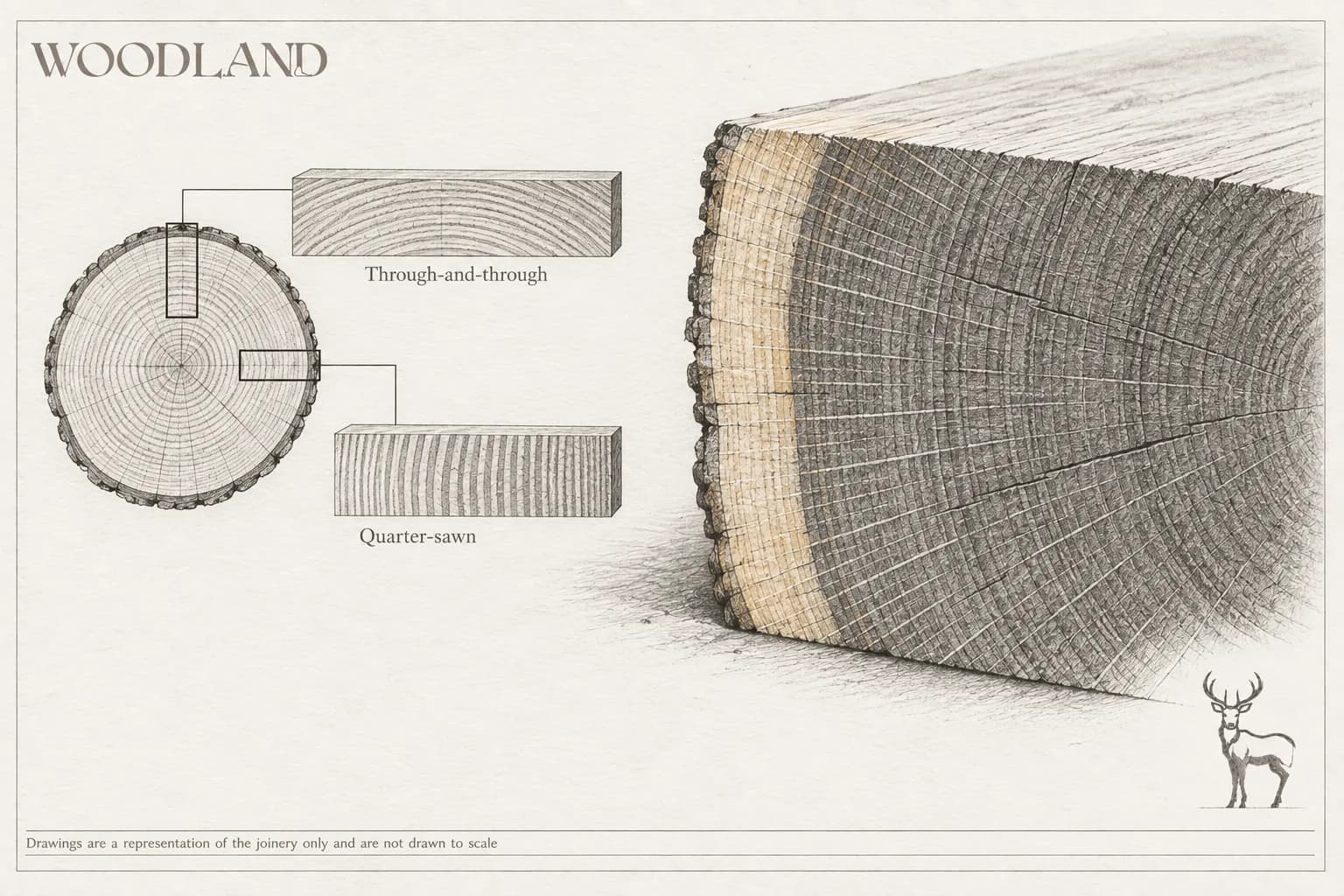
The second is which part of the tree. Sapwood is not durable in any species, including the durable ones: the classification applies to heartwood. Sapwood inclusions in an external section are a defect regardless of what the species is called, and they are the most common reason a correctly specified timber fails early.
The third is how it was cut. Quarter-sawn boards move less across their width and cup far less than through-and-through material, which is why the orientation of a section matters in a door stile or a window cill. The fourth is moisture content at the point of manufacture and installation. Timber worked wet and installed into a heated building will shrink after it is finished, and joints opened by shrinkage were not badly made — they were made at the wrong moisture content.
Availability is a design constraint, not a footnote
Period joinery frequently asks for sections that are long, wide and clear — free of knots and sapwood over their full length. Those sections exist, but they are the scarce end of any species’ supply, and the constraint is real enough to change a design. It is normally better to know that at drawing stage than to discover it when a section is being cut.
This is also where honest specification and honest sourcing meet. Accepting a shorter clear length, an engineered laminated section where it is not visible, or a different species for a component that will be painted are all legitimate answers. Substituting quietly and hoping the difference does not show is not, and it is the substitution that tends to surface at year ten rather than year one.
What a specification should actually record
Species and durability class. Heartwood only, stated explicitly, with sapwood excluded rather than assumed away. Cut and grain orientation for the components where movement matters. Target moisture content at manufacture, appropriate to where the joinery is going rather than to where it is made.
Then the chain of custody claim, recorded for what it is: evidence of provenance. Listing it alongside the performance requirements rather than in place of them is the whole point. A document that proves where timber came from and a specification that predicts how it will behave are both worth having, and neither substitutes for the other.
On period work, the timber has to match what is already there
Replacement joinery on a historic building carries an additional constraint that certification does not touch: the new material has to behave like the old. A conservation officer assessing a proposal will look at species, section, moulding profile and glazing pattern measured from what survives, and a substitution that performs well but reads wrong is still a refusal.
That frequently points at softwood rather than hardwood, which surprises people. A great deal of period joinery was made in slow-grown softwood of a quality that is genuinely hard to obtain now, and the honest answer on some elevations is a close match in the same species rather than an upgrade to oak. The studio’s guide to specifying joinery for a Grade II listed building sets out the evidence that argument has to carry.
What gets it right
Read the label, not the logo — 100 per cent, Mix and Recycled are different claims. Treat legality as a floor. Specify durability class and heartwood explicitly, because the species name alone does not cover it, and sapwood in an external section is the most common cause of early failure in timber that was otherwise correctly chosen.
Set the moisture content for the building the joinery is going into rather than the workshop it leaves. Resolve availability at drawing stage. And on period work, match what is there before improving on it — the certificate records where the timber came from, and the specification decides whether it lasts.