

Specified last, and the first thing to go wrong
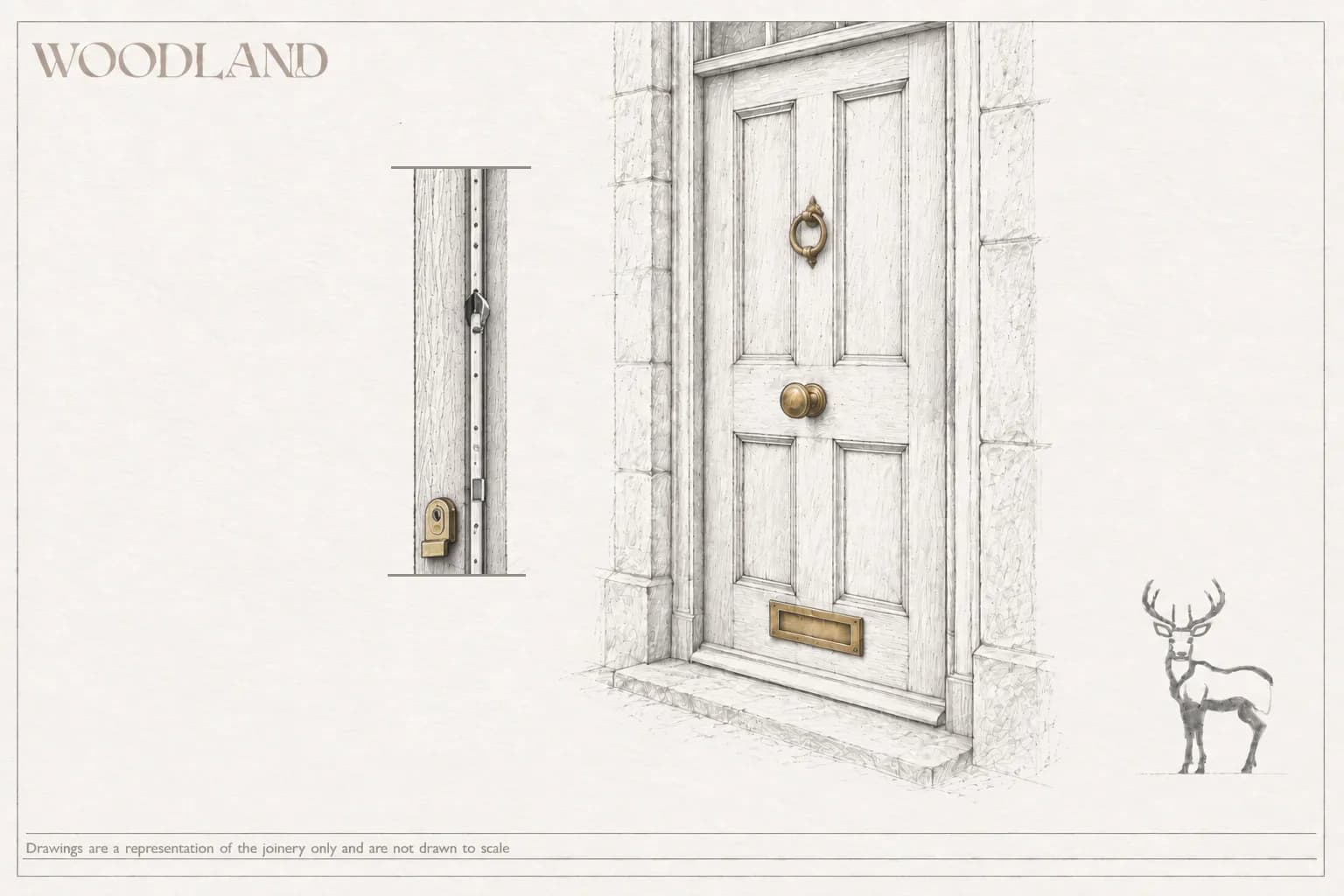
Ironmongery is the part of a door that clients most often source themselves, and the reason is understandable: it is the visible, choosable component, it photographs well, and it looks like a matter of taste. Handles, knockers, letterplates and hinges are sold as products in a way that a stile or a meeting rail is not.
The difficulty is that most of those choices are structural. A mortice lock is a void cut through the stile of a door, in the place where the door is already doing the most work. Hinges do not carry a door — they transfer its entire weight into the frame, and the frame into the masonry. A letterplate is a hole cut through a rail. None of that is decoration, and none of it can be reconsidered once the door is made.
So the order matters more than the selection. A door designed around known hardware is a different object from a door built to a drawing with hardware chosen afterwards to fit whatever survived. The second is the ordinary situation, and it is where the avoidable failures come from.
Weight decides more than taste does
A solid hardwood door set — particularly a glazed one, and particularly with a frame, fanlight and sidelights — is heavy in a way that catalogue hardware is frequently not rated for. The number and size of hinges follows from that weight, not from the convention that a door has three. Three is a starting point for a discussion, not an answer to it.
The more common failure is not the hinge itself but its fixing. A hinge sized correctly and screwed into a frame that is not adequately fixed back into the masonry will pull, and the symptom appears at the top of the door as a drop and a bind. On period openings, where the frame may be sitting in a wall that has moved for two centuries, the fixing is the question worth asking first.
Stile width is the other constraint, and it is the one that quietly removes options. Georgian and early Victorian doors often carry slim stiles, and a deep modern sashlock case can take out more of a slim stile than it can spare, leaving the strongest part of the door as its weakest. That single dimension frequently decides whether a mortice lock is available at all — which is the next question.
The pattern belongs to a date
The rim lock is surface-mounted on the face of the door and cuts nothing out of it. On early, cottage and thin historic doors that is not a compromise but the correct answer, and often the only one that does not weaken what it is fitted to. Mortice locks became general through the nineteenth century as door construction changed to accommodate them, and fitting one to a door that predates the practice is a decision to be taken deliberately rather than by default.
On front doors specifically, the centre knob is the period-correct arrangement on Victorian and Edwardian stock: a fixed knob roughly at the height the elevation expects, with the latch or lock operating separately. The lever handle on a front door is largely a twentieth-century domestic habit. Levers belong on the inside of the building, where they always did.
The smaller pieces set the register as much as the large ones. Letterplate size and height, the presence or absence of escutcheons, whether the knocker and the centre knob agree with each other — these read at a distance, and getting the position right matters more than getting the pattern rare. A correct knob at the wrong height reads wrong to someone who could not say why.
The metal and the timber have to agree
Oak is acidic. Ferrous metal in contact with oak, in the presence of any moisture, produces a blue-black stain that spreads from the fixing and runs down the face with the weather. Ordinary steel screws in an oak door will do it, and once it has happened the stain is in the timber rather than on it. Stainless steel or bronze fixings in oak, without exception — this is the single most common avoidable defect on otherwise good new oak joinery, and it is entirely a specification decision.
Brass raises a maintenance question that is usually mistaken for an appearance question. Unlacquered brass dulls evenly, takes a patina, and needs nothing done to it. Lacquered brass looks better on the day it is fitted and worse in a few years: the lacquer wears through where hands touch it, and the metal then tarnishes in patches around the intact film. Choosing unlacquered is choosing a finish that ages rather than one that fails.
The same logic runs through the other metals. Bronze weathers dark and holds. Forged iron is a different material from painted mild steel, which rusts at every fixing point and every place the coating is broken. On coastal and exposed elevations, salt finds plated finishes first, so solid metal outlasts plated metal by a margin that makes the initial comparison misleading.
On a listed building, the hardware may be the listed part
Listing covers the building and its fixtures, and original door furniture is frequently the oldest surviving component of a door — occasionally older than the door itself, having been moved from an earlier one when that was replaced. It is also the part most often removed without a thought, because a lock feels like a fitting rather than fabric.
The conservation default applies here as it does everywhere else: repair and retention before replacement, and the case for removal has to be demonstrated rather than asserted. Where an original lock genuinely cannot be made to work, leaving it in place and adding a discreet second point is usually far more acceptable than taking it off. Security requirements pull against this, and reconciling the two is a subject in its own right — the studio’s guide to security on a listed building takes it up separately.
The practical instruction is simple: on a listed door, assume the ironmongery is fabric until the local authority tells you otherwise, and ask before anything comes off. Listing is settled on the National Heritage List for England; what that listing covers in detail is a conversation with the conservation officer.
Specify it with the door, not after it
Ironmongery decided at design stage changes the door that gets made. Stile width can be drawn to accept the lock rather than the lock chosen to survive the stile. Rail positions can be set so that a letterplate does not land badly against a moulding. Hinge positions can be resolved against ledges and glazing bars rather than negotiated around them on site.
A specification worth the name records the weight, the hinge count and size, the lock type and case depth, the backset and spindle, the finish, the fixing material, and — most importantly on period work — what is being retained. That last line is the one most often missing, and it is the one that decides whether the door keeps its history or loses it in a fitting-out week.
What gets it right
Weight and stile width before pattern and finish, because those two dimensions remove options that no amount of later choosing can restore. Stainless or bronze in oak, always. Unlacquered brass unless there is a specific reason not to. A rim lock where the stile cannot afford a mortice, and no embarrassment about it — on the right door it is the more correct answer as well as the safer one.
On a listed building, treat the hardware as fabric until told otherwise, and ask before removing anything. And specify the whole of it alongside the door rather than after it, because every decision here is a decision about how the door is built.