

What “specifying joinery” actually means on a listed building
On an unlisted house, specifying a new window or door is a matter of taste, performance, and budget. On a listed building it is none of those things first. It is a question of permission. A Grade II listing protects the whole building — not just its façade, and not only the features the listing description happens to name — and joinery is one of the elements most often altered, most often badly, and most closely scrutinised when it is.
To specify joinery for a listed building is to write down, before manufacture, exactly what will be made and how: the timber, the sections, the moulding profiles, the glazing, the ironmongery, the method of construction, and the finish. On a listed elevation that specification is not an internal document. It is the thing a conservation officer reads, the thing listed building consent is granted against, and the thing the finished joinery is measured by. Get it wrong and the work either does not get consent, or gets made and then fails inspection. Get it right and it clears consent once and reads as though it was always part of the building.
Why listed status changes the brief
A listing is a legal designation, not a quality rating. Grade II — the grade that covers around ninety-two per cent of listed buildings in England — means a building of special architectural or historic interest, and it carries a specific consequence: it is a criminal offence to alter, extend, or demolish any part of it in a way that affects its character as a building of special interest, without listed building consent.
Two points follow that catch people out. First, listing is comprehensive: it covers the interior as well as the exterior, later additions as well as original fabric, and it is not limited to the features mentioned in the official list entry. An internal door, a staircase balustrade, or a run of secondary windows can all be protected even when the listing text describes only the front elevation. Second, “like-for-like replacement” is not automatically exempt. Replacing a rotten window with an identical new one can still require consent, because the existing window is itself protected fabric. The safe assumption on any listed building is that joinery work needs consent until the local authority confirms otherwise.
This is why the brief inverts. On a normal project the client’s wishes lead and the specification follows. On a listed building the building’s significance leads, consent sets the limits, and the specification is written to satisfy both before the client’s preferences are resolved within them.
What listed building consent requires for joinery
Listed building consent is granted by the local planning authority, advised by its conservation officer, and — for the most significant cases — by Historic England. The test the authority applies is whether the proposed work preserves the building’s special interest. For joinery, that test resolves into a small number of recurring questions.
Does the proposal retain historic fabric wherever it can be repaired rather than replaced? The conservation default is repair, not renewal: a window with decayed cills and sound sashes is repaired, not ripped out. Where replacement is genuinely necessary, does the new joinery match the old in material, profile, and detail? And is the evidence for that match documented — measured from what survives, or drawn from the period and the elevation where nothing does?
A consent-ready joinery specification therefore carries more than dimensions. It carries justification. It shows the surviving detail it is matching, names the profiles and sections, specifies the glazing and the glass, and explains each departure from the existing in conservation terms rather than in terms of convenience or cost. The specifications that clear consent the first time are the ones that have already answered the conservation officer’s questions on paper.
Working with the conservation officer
The conservation officer is the single most useful person in a listed building joinery project, and the most commonly mishandled. Treated as an obstacle to be got past, they slow everything down. Treated as a collaborator and engaged early — before a design is fixed, not after it is submitted — they tell you what will be accepted before time and money are spent finding out the hard way.
Early engagement does three things. It establishes what the officer considers the building’s significant joinery, which is not always what the owner assumes. It surfaces local precedent — what has already been accepted on comparable buildings in the same conservation area — which is the strongest evidence a specification can lean on. And it identifies the points the officer will scrutinise most closely, so they can be resolved in the specification rather than in a refusal. Ironmongery is frequently where an officer’s attention lands first; glazing pattern and glazing-bar profile are close behind. A specification agreed in principle with the officer before submission is a specification that gets consent.
Matching profiles: mouldings, sections, and sightlines
“Matching the original” is precise work, not a sentiment. Period joinery is recognised — by the eye and by the conservation officer — through its profiles and its proportions, and reproducing them means measuring and reproducing specifics.
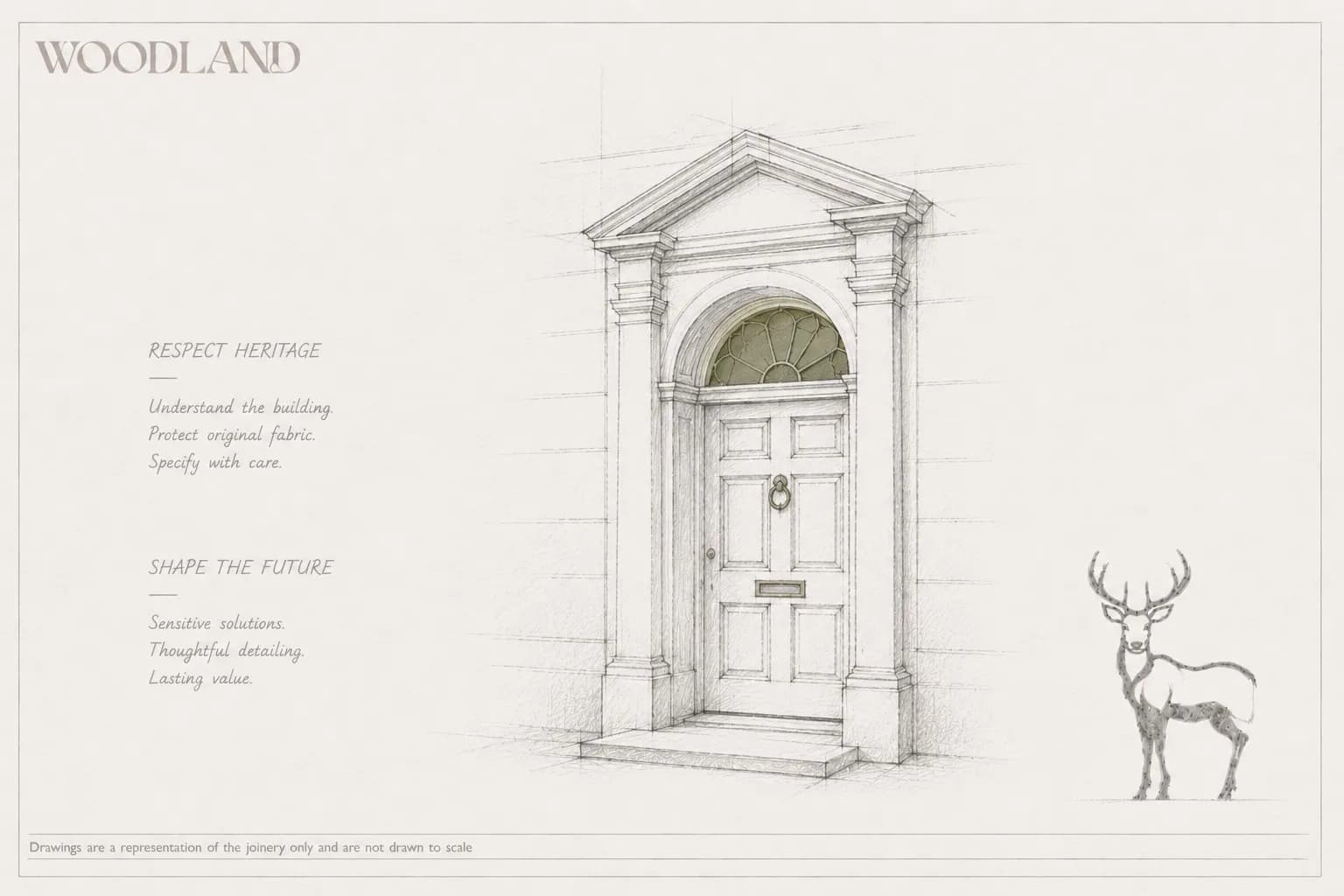
On windows, the controlling details are the glazing-bar width and profile, the sightline (the visible face of the frame and sashes), the meeting-rail depth on a sash window, and the way the sash horns are formed. A Georgian window carries fine glazing bars, often around 15 to 22 mm wide with an ovolo or lamb’s-tongue profile; a Victorian sash typically has broader bars and pronounced horns. Get the bar width wrong by a few millimetres, or substitute a flat modern bar for a moulded one, and a correct-looking window reads as a replacement at a glance. On doors and panelling, the equivalents are the stile and rail widths, the panel-moulding profile (ovolo, ogee, bead-and-butt), and the panel proportions. Where the original survives, these are recorded with a profile gauge and reproduced. Where it has been lost, they are drawn from the period and the elevation — never invented, never approximated to the nearest stock profile.
Timber selection and why it matters
Material is part of the specification a conservation officer will read, not a back-office decision. For most period joinery the historically and conservation-appropriate choice is slow-grown timber to match the original — typically a high-grade, tight-grained softwood (Douglas fir or a quality redwood) or European oak, selected for stability and for taking a traditional finish.
The temptation to substitute a modern engineered or modified timber (Accoya and similar) for its durability has to be weighed against the listing. On a prominent listed elevation, an officer may require like-for-like in species as well as profile; in less sensitive locations, or on a building where the original joinery is already lost, a modified timber may be accepted on its performance merits. The point is that the timber is specified to the building and agreed, not chosen by default and defended afterwards. Moisture content, grain orientation, and knot grading all belong in the specification because they determine whether the finished joinery moves, holds its finish, and lasts the decades a listed building expects of it.
Glazing: slim-profile units versus traditional putty bars
Glazing is where conservation principle and modern performance most often collide, and it is decided building by building. Two broad approaches sit at the ends of the range.
Traditional single glazing in putty-glazed bars is the conservation default on the most significant elevations: it reproduces the original glass line, the putty fillet, and the slender bar, and on a high-grade or prominent window it may be the only approach an officer accepts. Slim-profile double-glazed units — sealed units of around 11 to 14 mm overall, against the 24 to 28 mm of a standard unit — were developed specifically for conservation work, allowing a genuine glazing-bar profile and a near-historic sightline while adding thermal performance. Whether they are accepted depends on the grade, the elevation, and the conservation officer’s guidance: increasingly permitted on Grade II windows where the bar profile is maintained, still resisted on the most sensitive cases. Where consent does not allow altering the existing glazing at all, secondary glazing — an independent internal system that leaves the historic window untouched — is often the route to better performance without affecting protected fabric. Each of these is specified to the property’s grade and the officer’s guidance, not applied as a standard.
What a good joinery specification document contains
A specification that earns consent and produces the right joinery is a single coherent document, not a quote with dimensions. It sets out, item by item: the existing condition and what is being retained, repaired, or replaced; the timber species, grade, and moisture content; the sections and the moulding profiles, drawn or gauged from the original; the glazing specification and the glass; the ironmongery, to period; the method of construction and jointing; the finish and its build-up; and, running through all of it, the conservation justification for each decision against the building’s significance and the consent conditions.
Drawn to that standard, the specification does three jobs at once. It is the document consent is granted against. It is the instruction the joinery is made to. And it is the record that the work, once installed, can be measured against. The discipline is the same one that runs through every listed building project: decide it on paper, against the building, before anything is cut.
Common reasons consent is refused — and how specification avoids them
Refusals cluster around a short list of avoidable faults. Proposing replacement where repair was feasible is the most common: the conservation default is retention, and a specification that has not demonstrated why the existing fabric cannot be saved invites refusal. Incorrect or “near-enough” profiles are next — a glazing bar of the wrong width, a flat moulding where the original was moulded, a sightline that betrays a modern frame. Inappropriate glazing on a sensitive elevation, modern face-fixed ironmongery, an unsuitable timber substitution, and unsympathetic finishes each account for their share.
Every one of these is a specification failure before it is a consent failure. A specification that documents the existing detail, justifies repair-versus-replace, names period-correct profiles, specifies glazing and ironmongery to the building, and has been agreed in principle with the conservation officer before submission removes the grounds for refusal in advance. On a listed building, the specification is not the paperwork that follows the decision. It is where the decision is won.