

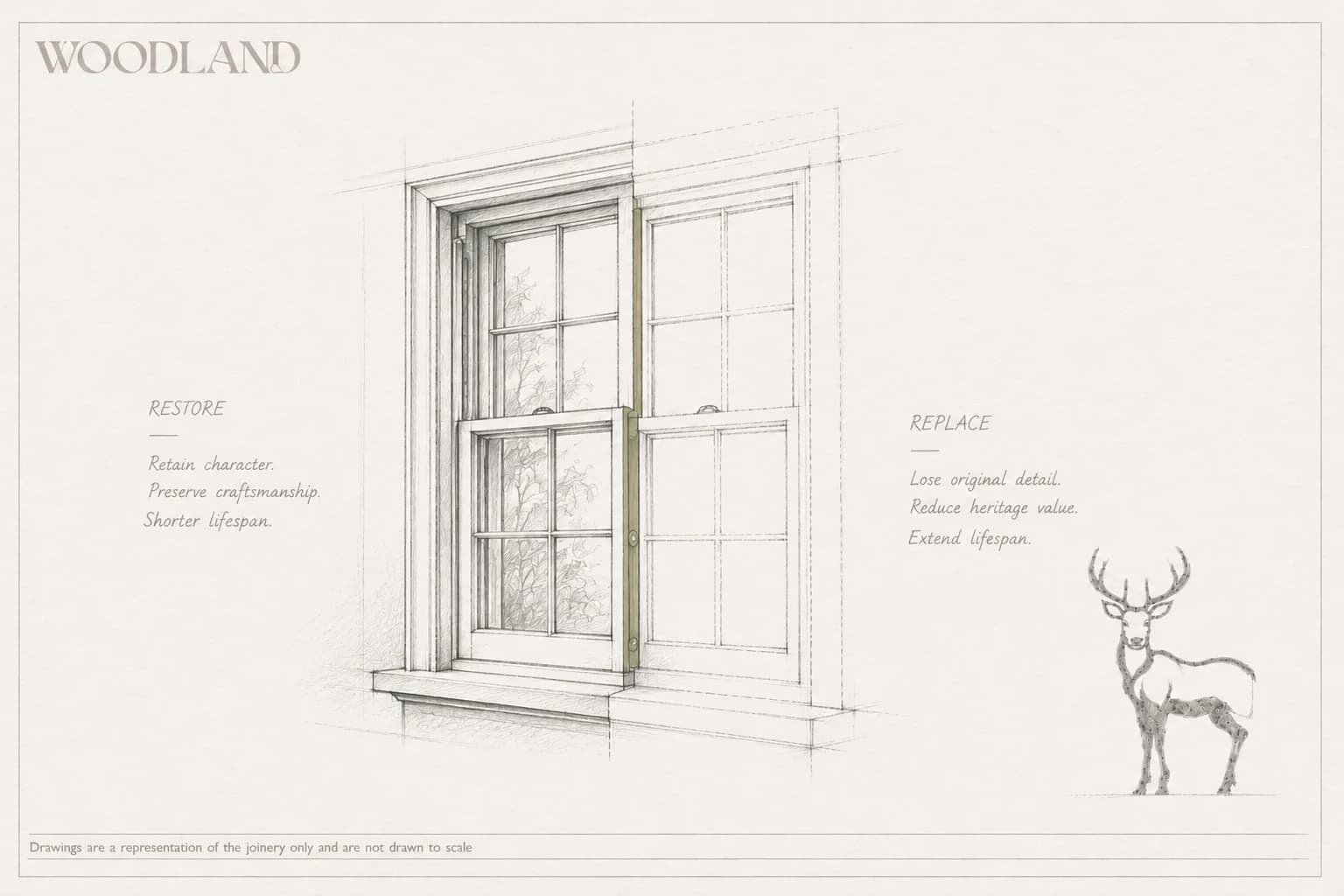
The question that should come first
Most sash window projects start with the wrong question — which replacement window to buy — when the first question is whether the existing window needs replacing at all. A sash window is a repairable object by design: it was built from individual components, jointed and pegged so that any one of them can be taken out and renewed. A great many sashes condemned as “rotten” have decay confined to a cill, a few inches of a stile, or the bottom rail, with the rest of the joinery sound. Establishing what is actually wrong — and how much of the window it affects — comes before any decision about replacement.
Why restoration is the conservation default
On a period property, and emphatically on a listed one, repair is the default and replacement is the exception that has to be justified. The reasoning is partly conservation principle — historic fabric, once lost, is gone — and partly material fact: the timber in an original sash is usually slow-grown softwood of a density and stability that is hard to buy today, and the joinery was made to be maintained. Listed building consent reflects this directly: an application to replace a repairable window is likely to be refused, because the test is whether the work preserves the building’s special interest, and needlessly discarding sound historic joinery does not.
What sash restoration actually involves
Restoration is not patching. A proper sash restoration is a defined set of operations: splice-repairing decayed sections of stile, rail, or cill with matched new timber let into the sound original; renewing cills and beads where they have gone; re-cording or re-chaining the sashes and overhauling or replacing the weights and pulleys so the window runs correctly; easing and re-aligning the sashes in the box; fitting concealed draught-sealing; and, where consent allows, glazing slim-profile double-glazed units into the existing or matched sashes. The result is the original window — sound, running smoothly, and with its appearance intact.
When replacement is the right call
Replacement is the right answer in specific cases, and saying so honestly matters. A sash that is decayed beyond economic repair — where so little sound timber remains that a “repair” would be a reconstruction — is a replacement. So is a window that has already been lost: a modern, poorly proportioned uPVC or stormproof unit in a period opening is not historic fabric to be preserved, and replacing it with a correct timber sash is a restoration of the elevation, not a loss. The judgement is about how much of the original genuinely survives, not about which option is easier.
If you do replace: the like-for-like standard
A replacement sash is only as good as its fidelity to the original. That means matching the sections, the glazing-bar width and profile, the meeting-rail depth, the sash horns, and the sightline — the details by which a period window is recognised — and matching the box, the reveal, and the way the window sits in the opening. A replacement that copies the opening size but coarsens the sections produces a window that is unmistakably modern in a period wall. The standard for a replacement is the one a conservation officer applies: it should be indistinguishable from a well-made original.
Cost and longevity, honestly compared
On headline price, a volume replacement window often undercuts a careful restoration, and that is the comparison that drives many wrong decisions. The honest comparison is longevity. A restored sash made from slow-grown original timber, maintained, lasts for generations — it already has. A replacement window is only as durable as its timber and its making; a cheap one fails far sooner than the window it replaced. Restoration of sound joinery is frequently the better long-term value as well as the better conservation outcome — which is not the same as saying it is always cheaper on the day.
The listed-building dimension
On a listed building the decision is not entirely the owner’s. Listed building consent governs whether a window can be altered or replaced at all, and the conservation officer’s starting position is retention. A specification built around repair, with replacement proposed only for genuinely unsalvageable units and on a documented like-for-like basis, is the one that clears consent. Approaching a listed sash as a replacement project from the outset is the fastest route to a refusal — and to a delay that costs more than the repair would have.
Energy and comfort without replacement
Much sash replacement is sold on comfort — draughts, cold, and noise — and most of that can be solved without replacing the window. The dominant problem in an old sash is air leakage, not the glass, and concealed draught-sealing addresses it directly. Secondary glazing adds insulation and cuts noise dramatically while leaving the sash untouched; shutters and lined curtains do more than they are given credit for; and, where consent allows, slim-profile or vacuum glazing can be glazed into a restored sash. The comfort argument for replacement is real, but it is rarely an argument that the original window has to go.
Making the decision: a framework
The decision resolves into a short sequence. Establish what is actually wrong and how much of the window it affects. Default to repair, and cost the restoration properly — including the running gear and the draught-sealing. Identify the few units, if any, that are genuinely beyond economic repair or are already non-original, and propose like-for-like replacement only for those. On a listed building, build the whole proposal around retention and agree it with the conservation officer before committing. Decide each window on its own condition, against the building — not the whole house on a single quote.