

Urban Designed
Pivot Door Sets
A pivot door turns on a point rather than swinging from hinges, which lets it be larger, heavier, and more dramatic than a conventional door. On a contemporary entrance, it is the architectural statement.
How a pivot door works
A pivot door rotates on a pivot hinge set into the floor and head, rather than on side hinges fixed to a frame. That removes the structural limit a hinged door has, so the door can be oversized — wider, taller, heavier — and still swing effortlessly. The result is an entrance with presence: a single large plane of timber, often full-height, turning on a concealed point. It is the door as the centrepiece of the elevation.
The pivot door as a modern statement entrance
On a contemporary house, the front door is the one piece of joinery everyone touches and everyone sees, and a pivot door turns that moment into the defining gesture of the elevation. Because it carries its weight on a pivot rather than on hinges, the leaf can be oversized — wider and taller than a conventional door — so a modern entrance reads as a single, generous plane of timber rather than a standard door set in a large opening.
That scale is what makes it a modern statement. Set flush into a rendered or clad wall, framed by full-height glazing, or finished in a deep painted tone, a pivot door anchors the entrance and sets the architectural tone for everything behind it. It is the detail a contemporary home is judged by before anyone steps inside.
Engineering and specification
A pivot door is an engineering problem as much as a joinery one — the weight has to be carried and balanced so a large, heavy door opens with a fingertip and closes true. The studio specifies the pivot mechanism to the door’s size and weight, builds the leaf from stable engineered timber so it stays flat, and details the threshold, seals, and locking for security and weather where the door is external. Finishes run from natural oak to fully painted.
Sizing, glazing and finishes for contemporary homes
A pivot door is specified to its setting. The leaf can run to full storey height and well beyond standard width, in solid timber, in timber framing a large glazed panel, or with a slatted and louvred face where the entrance is meant to filter light. Where glass is used it is high-performance double glazing, set within the timber so the sightlines stay clean.
Finishes follow the architecture: natural oak where the grain is the statement, or a fully painted contemporary tone where the door is one plane in a composed elevation. The pivot can be centred for symmetry or offset to one side for a longer leading edge, and the threshold, seals, and locking are detailed for weather and security wherever the door is external.
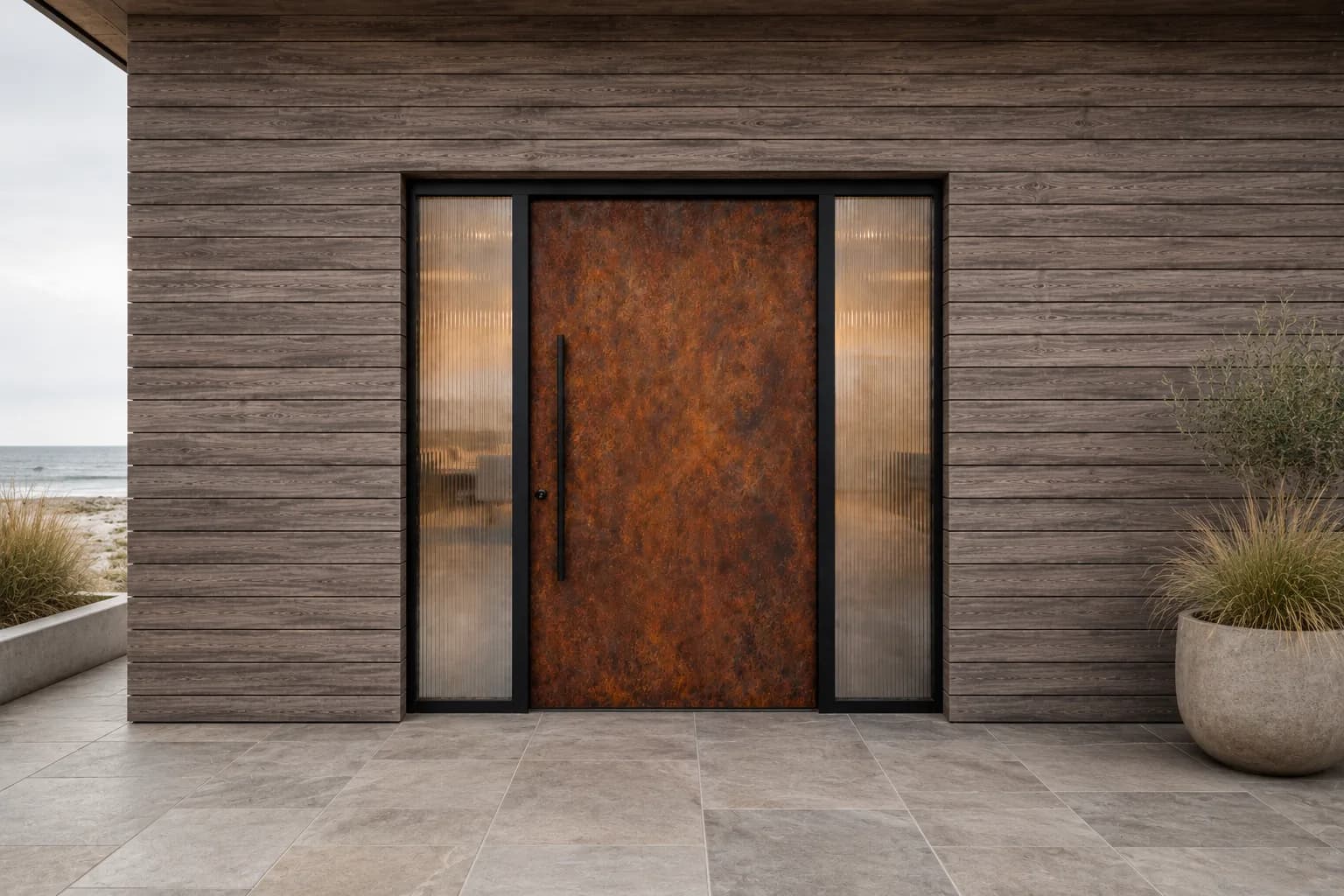
Where the entrance is meant to weather rather than stay pristine, the leaf can be faced in corten — weathering steel, which oxidises to a deep russet and then stabilises into a surface that holds its colour and texture rather than rusting through. The studio builds these as hybrids: a stable engineered timber core carrying a corten frontage, so the door keeps the warmth, insulation and movement of timber while the elevation gets the mass and patina of steel. Against pale render, grey aluminium glazing, or a clad wall, corten is the one face that carries colour without decoration, and a pivot leaf is large enough to let it read as a single weighted plane.
- Suits
- Contemporary entrances · statement front doors · architectural new builds
- Action
- Turns on a floor & head pivot — not side hinges
- Advantage
- Allows oversized leaves — wide, full-height, heavy
- Engineering
- Pivot specified to size & weight; engineered core to stay flat
- Finish
- Natural oak to fully painted, or a corten (weathering steel) frontage; external weather & security detailing
- Pricing
- From the drawing, not a list price
Common Questions
What is a pivot door?
A door that turns on a pivot point set into the floor and head rather than on side hinges, which lets it be larger and heavier than a conventional hinged door.
Why choose a pivot door?
For presence: it allows an oversized, often full-height single leaf that becomes the architectural statement of a contemporary entrance.
Are large pivot doors hard to open?
No. The weight is carried and balanced on the pivot, so a large door opens with a fingertip and closes true, when the mechanism is specified to its size and weight.
Can a pivot door be an external front door?
Yes. The leaf is built from stable engineered timber, and the threshold, seals, and locking are detailed for weather and security.
Can a pivot door have a corten front?
Yes. The studio builds corten and timber hybrids — a weathering-steel frontage over a stable engineered timber core — so the door keeps the warmth and movement of timber while the entrance gets the mass and patina of corten.
Considering pivot door sets for a contemporary entrance? The conversation starts here.
Start a Project →