

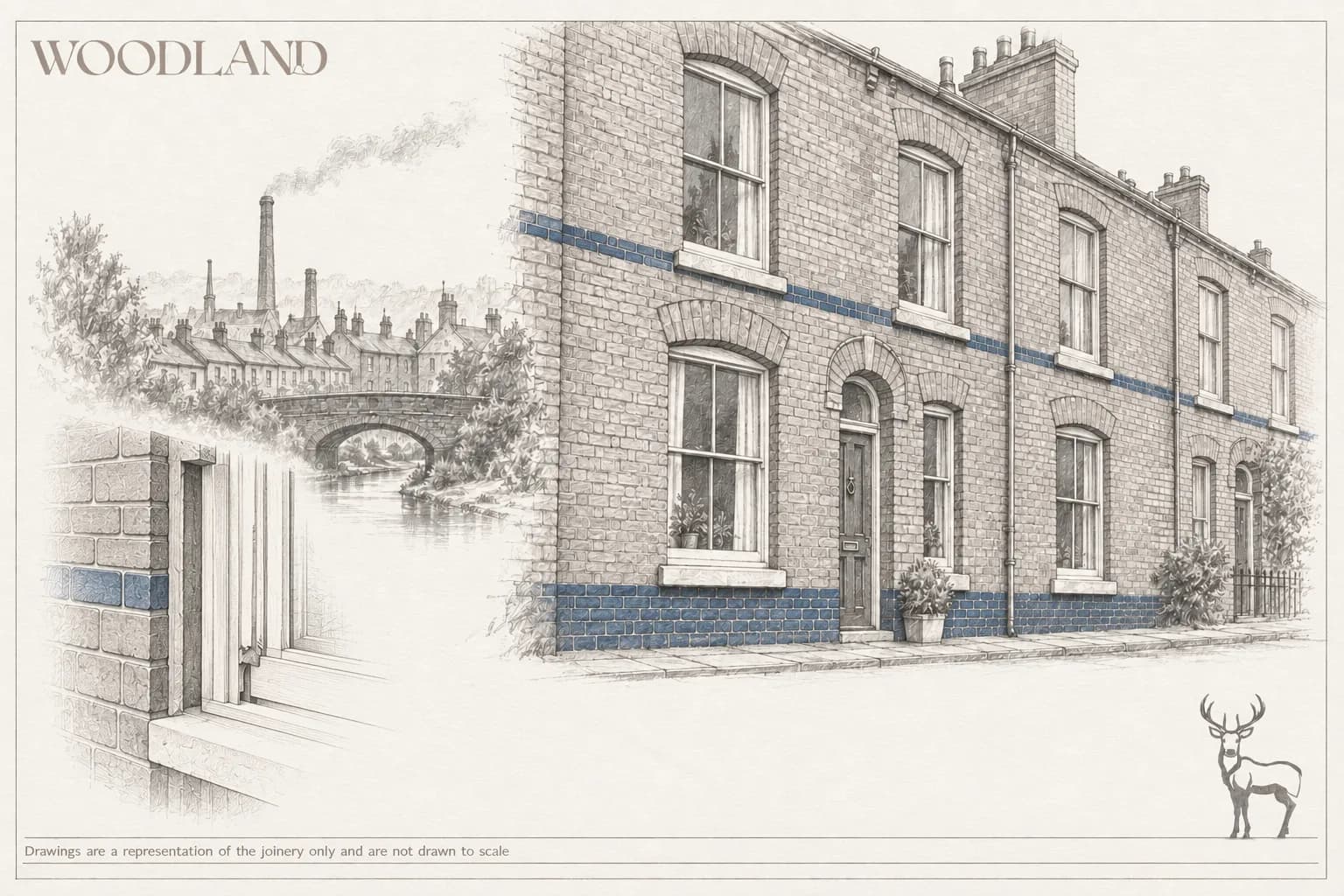
The West Midlands vernacular is brick — and it is not one thing
The regional constant is brick, and the reason is geological before it is industrial: the marls and clays under this part of the country made good brick, and the coalfield made it cheap to fire. What followed was a century of building in one material at enormous speed. That gives the region its unity — a red-brick continuity from the Black Country terraces through Birmingham’s Victorian suburbs to the Edwardian villas of Solihull and Sutton Coldfield — but the unity is a surface. Underneath it are several distinct building cultures that happen to share a material.
The oldest layer predates brick entirely and still survives in pockets: timber-framed halls like Blakesley Hall at Yardley, built in 1590, and Selly Manor, re-erected at Bournville by George Cadbury. Then the Jacobean brick statement houses, of which Aston Hall of 1618 to 1635 is the great survivor. Then the industrial workers’ housing of the Black Country. Then the Victorian and Edwardian suburban expansion that produced most of the region’s period stock. Then, at the end of that sequence and arguably the region’s most significant contribution, the Arts and Crafts movement — Bournville, and Wightwick Manor at Wolverhampton with its Morris and Company interiors. A joinery specification that treats all of that as one thing called period will be wrong about most of it.
The windows the brick was built around
For the bulk of the region’s period housing — the Victorian and Edwardian terraces and villas of Moseley, Edgbaston, Handsworth, Kings Heath and their equivalents across the Black Country — the defining window is the vertically sliding sash, set in a brick opening with a stone or brick cill and, very often, a segmental or gauged-brick arch above it. The proportion is doing the work: a tall, narrow opening with a heavier bottom rail and a fine meeting rail, glazing bars in the earlier stock and larger panes as the nineteenth century wears on.
The Arts and Crafts layer works differently and should be specified differently. There the window is typically a casement, often with leaded lights, sitting in a wider and lower opening, and the whole point of it is a horizontal emphasis where the Victorian sash is vertical. Swapping the logic of one for the other is the most common error on West Midlands period joinery — a sash proportioned like a casement, or an Arts and Crafts elevation given plate glass, reads wrong immediately even to someone who could not name why.
The conservation context
The West Midlands carries a dense and often underestimated conservation framework. Birmingham alone has a large number of designated conservation areas, and their character varies enormously — the Jewellery Quarter, with one of the densest concentrations of listed industrial buildings anywhere in the country, is governed on entirely different terms from a suburban villa area like Moseley or Edgbaston. The Black Country boroughs of Dudley, Sandwell, Walsall and Wolverhampton each carry their own designations, and Wolverhampton has Wightwick Manor on its edge as a reminder of how high the bar can go.
Two things matter practically. First, conservation areas in this region commonly carry Article 4 directions, which withdraw the permitted development rights that would otherwise let you replace windows and doors with similar-appearance units — that is precisely why original joinery survives in the areas where it survives, and it means a window replacement you assumed needed no permission may well need it. Second, Bournville operates under an additional layer: the Bournville Village Trust has exercised design control over the estate since 1900, separate from and additional to the planning system. Owners there are routinely surprised by it. Whether a building is listed is a separate question again, and one settled in minutes on the National Heritage List for England.
Materials that belong
Brick sets the palette, and the joinery has to answer to it rather than compete. The regional signature is red brick banded, plinthed and dressed with Staffordshire blue — a hard engineering brick that reads almost black in the wet and gives West Midlands elevations their particular severity. Against that, painted joinery is the historical norm rather than bare timber: these were painted buildings, and a stained or naturally finished window on a Victorian brick elevation is a modern intrusion dressed as a traditional one.
Glass is the other decision. Where original or early glass survives it is worth keeping, and secondary glazing will deliver most of the comfort without touching it. Where it does not, slim-profile double-glazed units in genuine timber bars can sit correctly in this stock, judged case by case — the point being that the bar is a real bar carrying real glass, not a bar stuck to the face of a sealed unit. On leaded Arts and Crafts lights the calculation is different again, and the presumption should be firmly towards retention and repair.
Doors and entrances in the West Midlands idiom
The regional entrance is a painted panelled door in a brick opening, and its period is legible from the panel arrangement and what sits around it. Victorian doors run to four or six panels, often with a fanlight above. Edwardian and interwar doors open up — fewer, larger panels, glazed upper lights, and the sidelights and gabled or bracketed porch canopies that give so much of the region’s suburban stock its face. Coloured and leaded glass in the upper light is genuinely characteristic here rather than a flourish, and where it survives it is usually the most valuable thing about the door.
The failure mode is consistent, and it is a proportion failure rather than a material one: a modern door leaf of standard dimensions dropped into an opening that was never standard, with the difference made up in packers and trim. The opening is the fixed thing. On this stock the door should be made to the opening, the panel layout should follow the period of the house, and the ironmongery should be quiet.
Working across the West Midlands
The studio works across the conurbation and its edges — Birmingham and its Victorian and Edwardian suburbs, Solihull, Sutton Coldfield, and the Black Country boroughs of Dudley, Stourbridge, Walsall, Sandwell and Wolverhampton. It is the nearest large body of period stock to the studio’s Shropshire and Worcestershire heartland, and the work runs from a single sash replacement in a conservation area to a full joinery package on a larger period house.
The practical advantage of a region built this fast and this consistently is that precedent is everywhere. What a local authority has already accepted three streets away is a matter of public record on its planning portal, and on this stock it is usually the most useful half-hour of research a project can have before anything is drawn.
What gets it right regionally
Read which layer the building belongs to before specifying anything — Victorian sash, Arts and Crafts casement and interwar suburban are three different disciplines, and the brick they share does not make them one. Take the opening as given and make the joinery to it. Keep the sightlines fine; the proportions on this stock are tighter than modern standard sections allow for. Paint, rather than stain. Establish early whether an Article 4 direction is in force, and at Bournville whether the Village Trust’s own controls apply, because both determine what is even worth drawing.
Done in that order, new joinery on a West Midlands period house is invisible in the best sense — the elevation reads as it was built to read, and the only evidence of the work is that the windows now open, close and hold heat. Where the building is listed, the same sequence applies with more evidence attached, and the studio’s guide to specifying joinery for a Grade II listed building sets that out in full.