

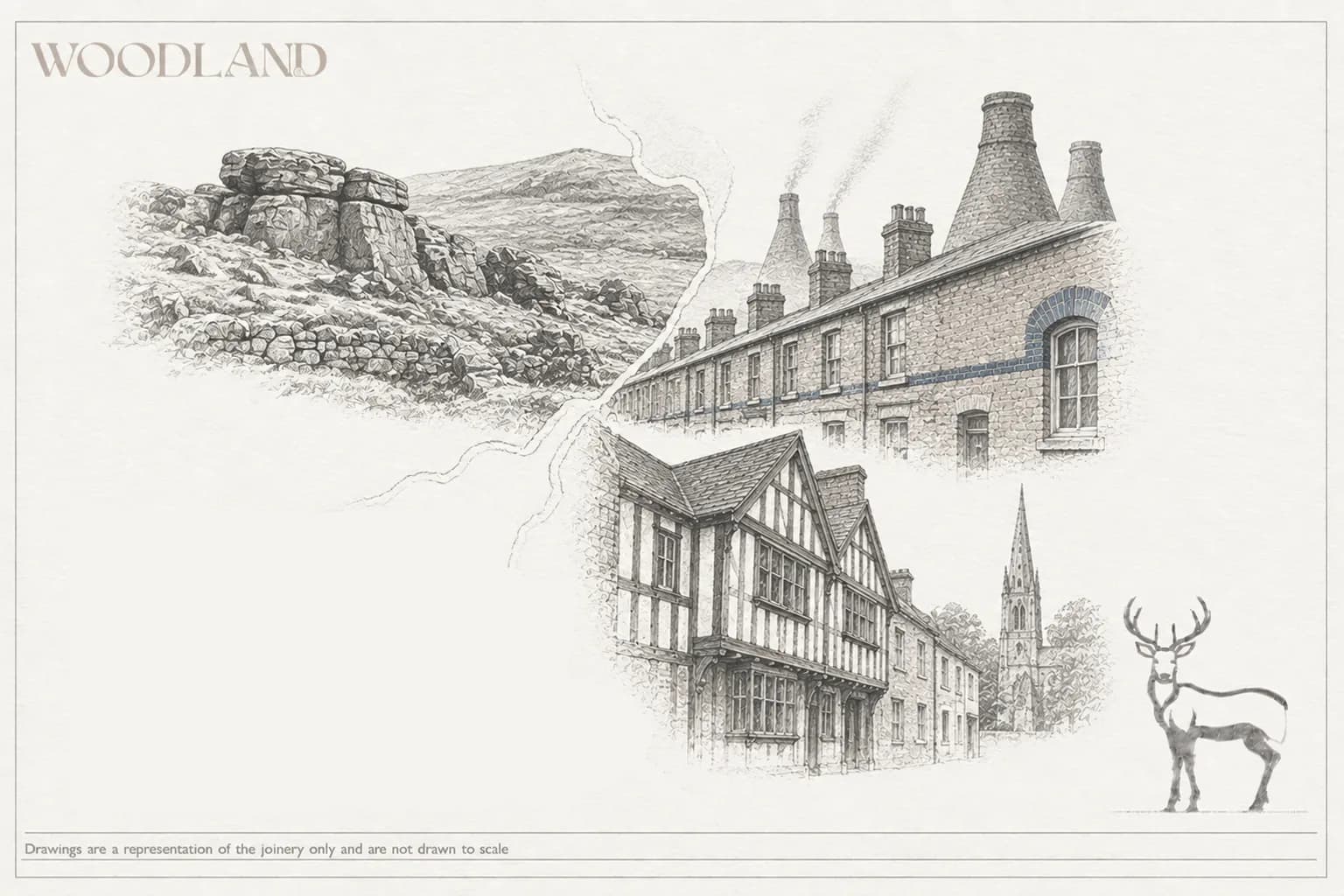
Three counties stacked north to south
The Staffordshire Moorlands, in the north-east, build in millstone grit — a hard, dark, coarse stone shared with the Peak District that the Moorlands run into. Buildings are low, heavy-walled and defensive against weather, with small openings and stone mullions. It is upland building, and it has more in common with Derbyshire than with anywhere south of Stoke.
The Potteries, through Stoke-on-Trent and its six towns, are the industrial county: terraced housing, works and warehouses in local brick, built fast and in enormous quantity around the pottery industry. Then the south and centre — Stafford, Lichfield, Tamworth, Uttoxeter — where the tradition is timber framing overlaid by Georgian brick. Stafford’s Ancient High House, built in 1595, is among the largest timber-framed town houses in England and a reminder that the framing tradition here was once as strong as Herefordshire’s. Lichfield, a small cathedral city, carries the county’s best Georgian stock.
The unifying material, ironically, is the one Staffordshire exported: the blue engineering brick fired from Etruria marl that gives Midlands elevations their banding and plinths. It is everywhere in the county’s own building too, and it is a good diagnostic — where you see it, you are usually in nineteenth-century or later work regardless of what the rest of the elevation suggests.
Stone mullions, industrial sashes, Georgian proportion
Each of the three Staffordshires has its own window. In the Moorlands it is a stone-mullioned opening, wide relative to its height, historically with leaded or small-paned glazing and a heavy stone surround doing the structural work. The joinery sits inside a masonry opening that will not change, and the discipline is to keep the timber fine enough that the stone still reads as the frame.
In the Potteries it is the vertically sliding sash of industrial terraced housing — plainer and smaller than its Birmingham equivalent, often with a segmental brick arch above and a plain brick or blue-brick cill. The stock is modest and the temptation is to treat it as unimportant, which is how whole streets lose their character one house at a time; in a conservation area it is also how owners discover an Article 4 direction the hard way.
In Lichfield, Stafford and the southern market towns it is the Georgian sash proper: taller, better proportioned, with fine glazing bars and the pane arrangement of its date. Here the terrace or street rhythm matters as much as the individual house, and specification should be drawn from neighbours as much as from the building itself.
The conservation context
The county’s designations are concentrated rather than uniform. Lichfield’s historic core is tightly controlled and its cathedral close is among the most complete in the country. Stafford, Tamworth, Uttoxeter and Leek all carry conservation areas, and Leek in particular holds a strong body of Arts and Crafts work that raises the bar considerably. In the far north-east the Peak District National Park reaches into the county, bringing its own and notably strict design expectations for anything visible in the landscape.
The Potteries present a different picture. Much of the industrial stock is unlisted and unprotected, but the surviving bottle kilns and the better works buildings are listed and often at high grade, and conservation areas cover parts of the six towns. The practical point is that protection in Staffordshire is patchy in a way it is not in Herefordshire — two adjacent streets can sit under entirely different regimes, so the check has to be done per property rather than per town. Listing is settled on the National Heritage List for England; Article 4 status has to come from the local authority.
Materials that belong
In the Moorlands, timber that defers to stone: fine sections, modest openings, and no attempt to make the window the feature. In the Potteries and the southern brick towns, painted joinery — this is brick-and-paint country, and a stained or bare frame reads as modern on almost any Staffordshire brick elevation. In the framed buildings of the south, oak, as the frame demands.
Glazing follows the usual conservation hierarchy with one local emphasis. The Moorlands’ small stone-mullioned openings admit little light to begin with, so heavy modern sections and thick sealed units cost proportionally more daylight here than in a larger opening — an argument for slim profiles where double glazing is appropriate at all, and for secondary glazing where any historic glass survives.
Doors and entrances across the county
Moorlands doors are boarded and heavy, hung in stone openings, with substantial ironmongery — built against weather rather than for display. Potteries terraces run to plain four-panel painted doors, often with a simple overlight, and their virtue is uniformity along the street. Lichfield and the Georgian towns carry six-panel painted doors with fanlights and, on the better houses, a proper cased surround with pilasters and a hood.
The recurring error across all three is scale. A Georgian door pattern on a Potteries terrace is too grand and looks it; a plain four-panel door on a Lichfield townhouse is too mean. The street sets the register, and on this county’s stock the street is usually a more reliable guide than the individual building, which may well have been altered.
Working across Staffordshire
The studio works across the county — Lichfield, Stafford, Tamworth and Uttoxeter in the south and centre, Stoke-on-Trent and the Potteries towns, and Leek and the Moorlands villages to the north-east. Staffordshire adjoins both the studio’s Shropshire base and its West Midlands work, and the southern half of the county shares a building vocabulary with both.
The practical advantage in the brick towns is the same as in the West Midlands: precedent is dense and public. What a local authority has already accepted on a comparable elevation nearby is on its planning portal, and on modest stock that record is often the most persuasive thing an application can cite.
What gets it right regionally
Locate the building in the county’s north-to-south sequence before specifying: gritstone upland, industrial brick, or Georgian and framed market town. Check protection per property rather than per town, because Staffordshire’s designations are patchy and neighbouring streets frequently differ. Paint on brick, oak in frames, and fine sections against stone. Take the register from the street on terraced and town stock.
Where the building is listed — most likely in Lichfield, Leek, the Moorlands or on a surviving Potteries works — the studio’s guide to specifying joinery for a Grade II listed building sets out the evidence a consent application has to carry.