

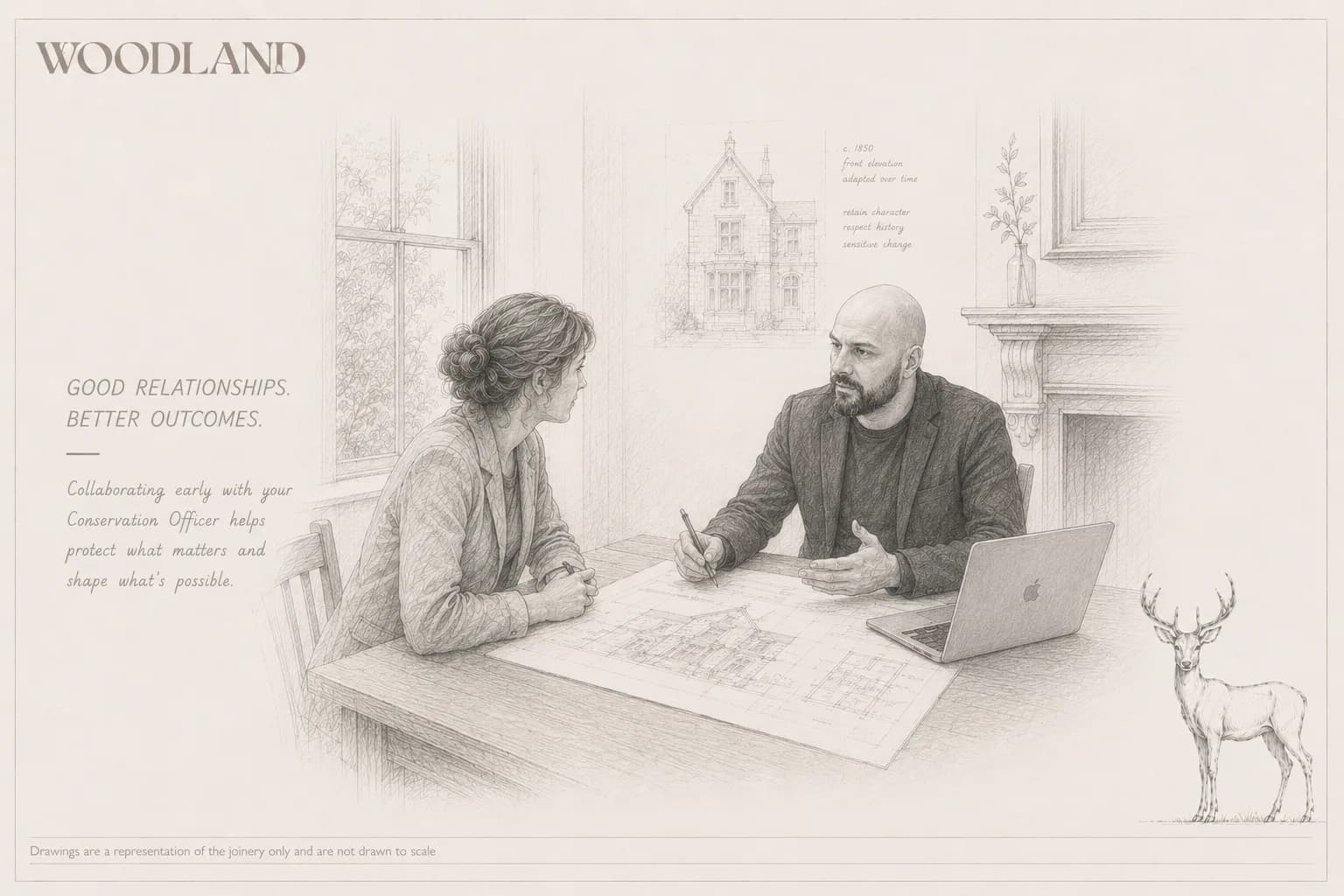
What a conservation officer actually does — and whether they decide your application
A conservation officer is the local planning authority’s specialist adviser on historic buildings. They do not, formally, decide listed building consent — the planning officer or committee does. In practice, their advice is usually decisive: where a conservation officer objects, the case officer will rarely recommend approval over their head. Understanding that distinction matters, because it tells you who the specification has to persuade, and it explains the escalation routes later in this article.
It also helps to know the conditions they work under. Local authority conservation staffing in England fell by around a third between 2006 and 2018, and the decline has continued since — many councils now share one officer across hundreds of listed buildings, and some have no in-house specialist at all. An officer who seems slow, cautious, or reluctant to commit is very often an overloaded specialist protecting themselves against the one approval that goes wrong. That is not a defence of poor service; it is the context that makes the strategy in this article work. The owners who get on well with conservation officers are the ones who make the officer’s job easy.
Do I need to speak to the conservation officer before I apply?
Yes — and earlier than feels natural. Historic England’s advice to owners is to consult the local authority at an early stage of developing proposals, and the Society for the Protection of Ancient Buildings says plainly that the earlier you consult, the better. The mechanism is pre-application advice: an exchange, sometimes with a site visit, before any formal application is made.
Two honest caveats. First, pre-application advice is increasingly charged for — fees vary from nothing at some councils to well over a thousand pounds at others, and some authorities offer free pre-application advice specifically for energy-efficiency retrofit works, which is worth asking about if glazing performance is part of your project. Second, owners are sometimes frustrated that even paid advice comes hedged — some councils state outright that the officer will not give a definitive view at pre-application stage. Treat pre-application not as a place to get a yes, but as a place to learn what the officer considers significant about your building, what has been accepted on comparable properties nearby, and where the sensitivities lie. That information is what a consent-winning specification is built from.
Why won’t the conservation officer tell me what they will accept?
This is the single most common complaint owners raise, and it has three real causes. Officers are advisers, not decision-makers, so a promised outcome is not theirs to give. They are assessing your building’s particular significance, not applying a national pattern book — which is also why the identical-looking approval three doors down is not the precedent it appears to be, if that building’s fabric, grade, or surviving detail differ. And an overloaded officer has every incentive to stay non-committal until there is something precise in front of them.
The unlock is to change what you ask. An open question — “what would be right for this building?” — invites the officer’s expertise instead of asking them to underwrite yours, and experienced owners consistently report it transforms the conversation. Then give them something concrete to react to: photographs of the surviving joinery, measured profiles, a drawing of what is proposed, and examples of what the authority has already approved on comparable buildings — all of which is searchable on the council’s planning portal. Vague proposals get vague answers. Precise, evidenced proposals get real ones.
Do I need consent to replace the doors or windows — and what about repairs?
The short version, covered fully in the studio’s guide to listed building consent: genuine repair, where the historic fabric substantially survives, generally needs no consent; wholesale replacement — even like-for-like — needs listed building consent, because the existing joinery is itself protected fabric. The conservation default is always repair before replacement, and the officer will expect the case for renewal to be demonstrated, not asserted. Applying for listed building consent itself carries no fee in England; the real investment is the drawings and justification the application stands on — which is also exactly the material that wins the officer over at pre-application stage. The two costs are really one.
Can I have double glazing in a listed building?
The folklore says never; the current position is more nuanced, and it shifted meaningfully in owners’ favour with Historic England’s 2024 retrofit guidance. Where no historic glass survives and the frames can take it, slim-profile double-glazed units in genuine timber bars may be acceptable without harming the building’s significance — judged case by case. Where the glazing must stay, reversible secondary glazing delivers most of the comfort with none of the harm, and generally without consent. What remains effectively impossible is the uPVC or off-the-shelf route. If an officer seems “twitchy” the moment double glazing is mentioned, it is usually because they are picturing the standard product; a specification built on the conservation-grade options is a different conversation, and it is precisely where specialist joinery drawings earn their keep.
The conservation officer said no. Has anyone challenged them — and is it worthwhile?
Refusal is not the end, and there are two roads. The formal one is an appeal to the Planning Inspectorate — free to make for householders, but slow, and decided on the same conservation tests by an inspector who gives significant weight to the authority’s reasoning. The practical one, which experienced owners and heritage consultants usually recommend first, is to treat the refusal as a specification: read the reasons, fix precisely what they object to, gather the evidence the first application lacked — precedent approvals, a fuller justification of why repair is not viable, corrected details — and resubmit. A refusal that says “insufficient justification” is an invitation to justify, not a verdict on the project. Where the disagreement is genuinely about judgement rather than evidence, a heritage consultant’s report can reframe the case — a real cost, but usually a faster and safer one than an appeal fought on thin drawings.
Will the conservation officer come back and inspect the finished work?
Usually not — and owners are often surprised by this. Unlike building control, listed building consent typically carries no formal completion inspection; officers rarely have the resource to revisit. That cuts both ways. Nobody signs the work off, so the consent documents and photographs of the completed joinery become your record — worth keeping meticulously, because the question that will eventually be asked is a buyer’s solicitor’s, years later. And work that quietly departs from the approved drawings is not made safe by the absence of an inspection; it is simply unauthorised work waiting to be noticed, with no time limit on the noticing.
What a specialist joiner changes about the conversation
Most of the friction in this article has the same root: the officer is asked to approve an intention rather than a specification. The studio’s role on a listed building project is to close that gap before the application goes in — recording the surviving profiles, drawing the proposed joinery to the level an officer can actually assess, specifying glazing to the building rather than from a range, and preparing the drawings and sections a consent application requires. An officer handed that package is no longer being asked to trust; they are being asked to check. That is the version of the conversation that ends in consent — usually the first time.