

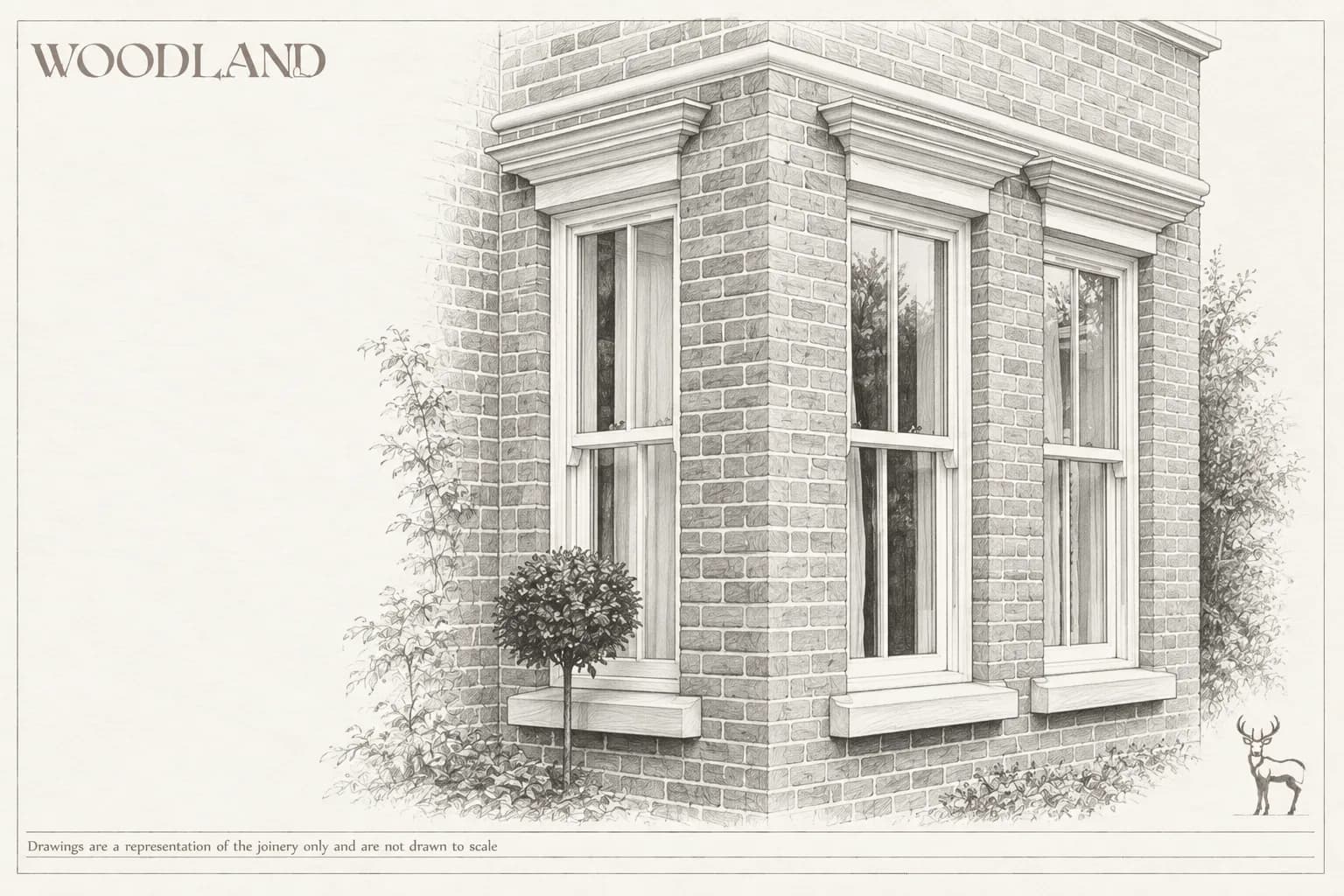
It is an assembly, and it fails at the junctions
The parts are the frame or box, the opening light — sash or casement — the cill, the glazing bars, the glass and its bedding, and the ironmongery. Each is straightforward on its own. What decides whether a window lasts is how they meet: where end grain meets weather, where glass meets timber, where the opening light meets the frame, and where the whole assembly meets the masonry.
That is why comparing windows by species or by glazing specification alone is unreliable. Two windows in the same timber with the same units can have completely different lives depending on how their junctions were drawn. It is also why the failures are so predictable — walk any street of period property and the rot is in the same places on every house.
Section and sightline: the part everyone sees and few name
Sightline is the width of timber visible when you look at the window straight on — the meeting rail, the stiles, the glazing bars. It is the single characteristic that most decides whether a replacement reads as correct, and it is what people are reacting to when they say a new window looks wrong without being able to say why.
Period sightlines are slim because the glazing they carried was thin and light. Modern sealed units are thicker and heavier, and the sections have to grow to house and support them, which is how a like-for-like replacement ends up visibly fatter than what it replaced. Every decision about performance eventually arrives at this trade, and on a period elevation the sightline is usually the thing that must not move.
Section depth matters as much as visible width, because it governs how much timber sits between the weather and the inside, how deep a drip groove can be cut, and whether the joint has material to be made in. A window drawn thin for looks and thin in depth has nowhere left to put the water detail.
The cill and the bottom rail are where windows die
Water is the whole problem and gravity decides where it collects. The cill, the bottom rail and the lower ends of the stiles take the runoff from the entire opening, so that is where the timber stays wet longest and where end grain is most exposed. On almost every rotten period window the damage is in that band, and the top of the same window is sound.
The details that prevent it are small and specific. A weathered cill sheds water away from the building rather than holding it. A drip groove — the throat cut into the underside of the cill’s projection — breaks the surface tension that would otherwise pull water back along the underside and into the wall. Capillary breaks between meeting surfaces stop water being drawn into a joint by the gap itself. End grain wants sealing before assembly, not after, because once the window is together the vulnerable faces are the ones you can no longer reach.
None of this is visible in a finished window, which is precisely why it gets left out. A window without a drip groove looks identical to one with it for about five years.
The joint decides whether it can be repaired
A traditional sash or casement is jointed with mortice and tenon, wedged and often through-wedged, sometimes pegged. It is a mechanical joint: it holds because of its geometry, and it can be taken apart and remade. That is why so much period joinery is repairable a century and a half later, and why splicing a new bottom rail into an otherwise sound sash is ordinary work rather than heroic.
Dowelled and glued joints, common on volume-manufactured timber windows, rely on the adhesive rather than the geometry. They are quicker to make and perfectly serviceable, but when they fail they fail as a unit and the repair is replacement. On period work that difference is not a detail — it decides whether the next generation repairs the window or skips it, and repairability is the conservation argument as well as the economic one.
Putty or beads, and what each costs you
Traditional single glazing is bedded in linseed oil putty, which is soft enough to be raked out and renewed and which gives the fine external line that period glazing bars depend on. It is also maintenance: putty needs painting to survive and needs replacing periodically, and a window whose putty has been left unpainted is a window taking water at every pane.
Beads hold heavier glazing and are the practical answer for sealed units, but they add width to the visible section, which brings the argument straight back to sightline. Where an insulated unit is appropriate at all, slim-profile units and carefully drawn beads keep the loss small — that is a subject in its own right, and the studio takes it up separately in its writing on conservation glazing.
A glazing bar’s job is structural as well as visual on a single-glazed window, and it stops being structural when the pane behind it becomes a single sheet. Applied bars stuck to the face of a large unit read wrong at an angle and in low sun, which is when period elevations are most looked at.
The window will move, and it has to be allowed to
Timber moves across the grain with humidity, and an external window swings through that range every year. The clearances around an opening light are set for the wet end of that cycle, not the dry end, which is why a window that shuts perfectly in high summer can bind in February. A sash that has been eased to fix a seasonal bind is a sash with a permanent gap for the other half of the year.
The same logic governs how the window meets the masonry. A frame packed tight into an opening that is itself moving will transfer that movement into the joinery. The joint between frame and wall is a designed gap with a designed seal, not an absence of one.
What gets it right
Judge the sightline first, because it is what makes a window read correctly and it is the thing hardest to recover once lost. Then look for the water details — weathered cill, drip groove, capillary breaks, end grain sealed before assembly — because they are invisible, they are where the window will die, and they are the first things omitted when a price is being met.
Ask how it is jointed, because that decides whether it can be repaired or only replaced. And set the clearances for the wet end of the year, then leave them alone. A window that has all of that and an ordinary species will outlive a window that has none of it and an expensive one.