

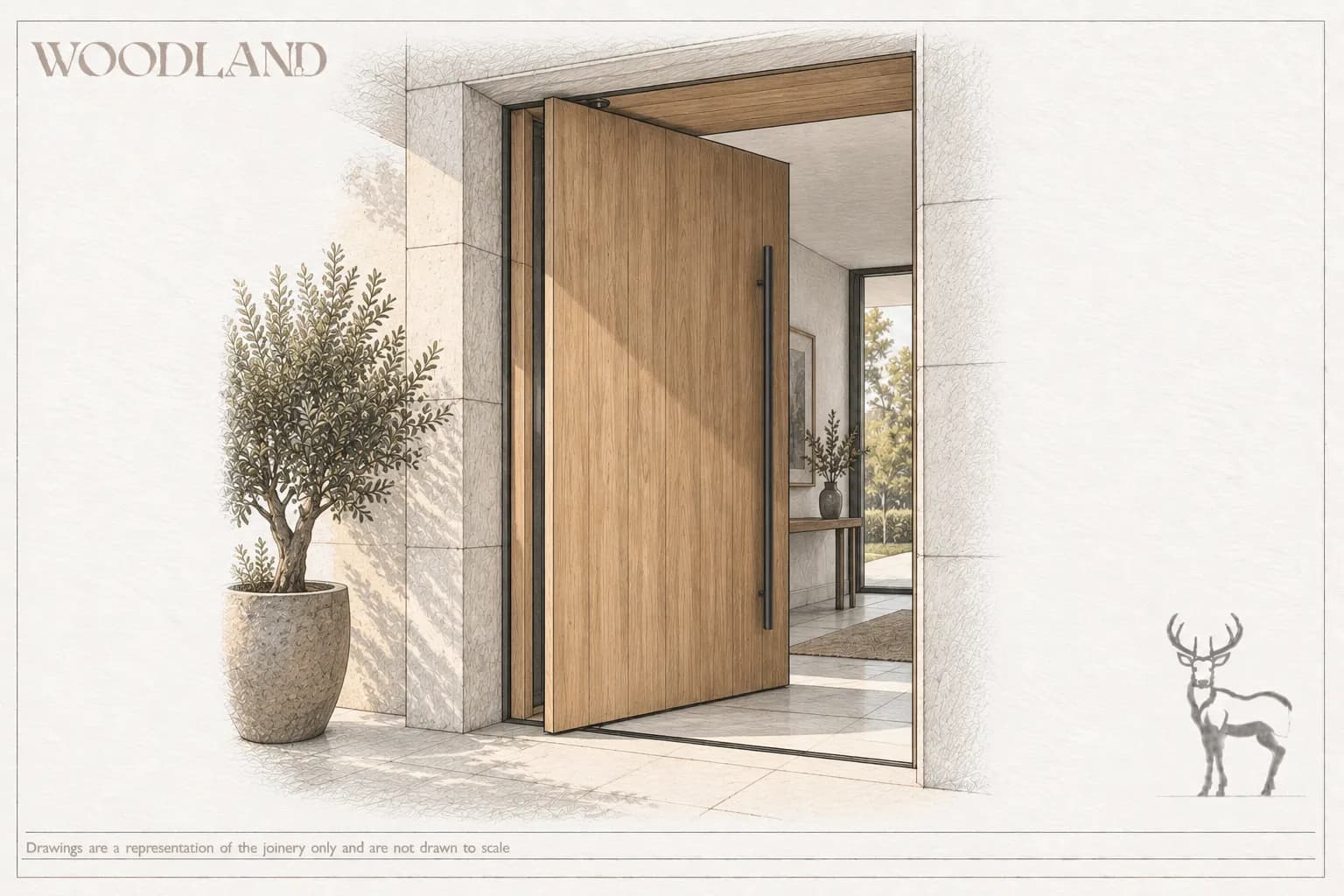
The load path is the whole point
A hinged door hangs off the jamb. Every kilogram of leaf is cantilevered off one side of the frame, which is why hinge size, hinge count and the frame’s fixing into the masonry are the limits on how big a hinged door can sensibly be — and why heavy hinged doors drop.
A pivot door rotates on a point at the head and a point at the floor. The weight goes almost entirely downwards into the structure below rather than sideways into the jamb, and the head pivot is doing alignment rather than carrying much load. Because nothing is cantilevered, the leaf can be very large and very heavy without the failure mode that limits hinged doors.
That is the advantage, and it comes with the obligation. The floor has to be able to take a concentrated point load and hold it dead still, permanently. On a solid slab that is straightforward. On a screed of uncertain depth, a suspended timber floor, or over underfloor heating pipes, it is a question to answer before the door is drawn — not a fixing to work out on site.
Offset or centre, and what each costs
A centre-pivoted leaf rotates about a point away from the edge, so as it opens, part of the door swings into the opening and part swings out. It is the arrangement that gives the dramatic wide entrance, and it needs clear space on both sides. It also means the leaf cannot be sealed continuously around its perimeter in the way a hinged door can, because the geometry of the rotation opens a gap at the pivot side.
An offset pivot moves the axis close to the edge, so the door behaves much more like a hinged one — most of the leaf swings one way, the perimeter can be sealed conventionally, and the opening is usable in a narrower space. It gives up some of the theatre and gets back most of the weather performance.
That trade is the specification decision. A centre pivot on a fully exposed elevation is the hardest thing to weather-seal in domestic joinery. An offset pivot on the same opening is a normal problem.
A large leaf has to be built to stay flat
This is where pivot doors are won or lost, and it is invisible in a photograph. A large single leaf has a great deal of area and very little to restrain it, so any tendency to move shows as a twist or a bow — and on a wide door a small twist becomes a visible gap and a seal that no longer meets.
The answer is balanced construction. A stable engineered core rather than solid boards, faced symmetrically so that whatever the two faces do, they do it equally and cancel out. Face one side and not the other, or use different materials or thicknesses on each face, and the leaf becomes a bimetallic strip: it will cup towards the side that moves more, and no amount of ironmongery will hold it flat.
The same discipline applies to finish. Sealing one face and leaving the other unsealed lets moisture in and out at different rates on either side of the leaf, which produces exactly the movement the construction was designed to avoid. Both faces and all four edges, including the top edge nobody sees.
Weather-sealing is harder, and it is the usual complaint
The rotation is the problem. A hinged door closes against a stop on all four sides and compresses a seal into it. A pivot leaf arrives at the closed position by rotating, so a conventional compression seal at the pivot edge would be wiped rather than compressed, and the leading edge needs clearance to swing past the frame at all.
The workable answers are a combination rather than a single item: brush and blade seals that tolerate a wiping action, a drop seal at the threshold that deploys only when the door closes, and — most importantly — a reveal and threshold detail that keeps driving rain off the leaf’s edges in the first place. A deep reveal or a covered entrance does more for a pivot door’s weather performance than any seal specification, which is a design decision taken long before the door is ordered.
It is worth being straightforward about this: on a fully exposed, weather-facing elevation, a large centre-pivoted door is a demanding proposition and it is reasonable to choose something else.
Where a pivot is the wrong answer
On most period elevations. A pivot door is emphatically a contemporary gesture: it reads as one, and on a Georgian or Victorian front it is a visible anachronism in a way that a well-made panelled door is not. Where the building is listed, that is also a consent conversation with a predictable outcome.
In small openings, where the width that makes a pivot worthwhile does not exist and it is simply an unusual way to hang an ordinary door. Where the floor cannot be made to take and hold a point load. Where the entrance is fully exposed and the seal has to do all the work. And where the door is high-traffic in a way that means it will be left standing open in the wind — a large leaf catching a gust puts that load straight into a single floor fixing.
What to ask before specifying one
What is the floor, and can it take a permanent concentrated point load without movement? Offset or centre, and has the weather consequence of that choice been accepted rather than discovered? How is the leaf built — is the core engineered and stable, and is the facing balanced on both sides?
Is every face and every edge finished, including the top? What seals the perimeter, and how do they cope with a wiping action rather than compression? And what is the exposure — because a covered or deeply reveal’d entrance turns a demanding specification into an ordinary one.
What gets it right
Start with the floor, because the pivot puts the whole weight of the door into a single point and the structure below decides whether that is viable. Choose offset unless the theatre of a centre pivot is genuinely worth the weather penalty, and take that decision knowingly.
Build the leaf balanced — engineered core, symmetrical facing, every face and edge sealed — because a large door that twists cannot be corrected afterwards by anything. Combine seals rather than relying on one, and let the reveal and the threshold do most of the work. And keep it off period elevations, where it is the wrong gesture regardless of how well it is made.