

What corten actually is
Corten is weathering steel. The name is a trademark — the generic material is a low-alloy structural steel, specified in Europe under EN 10025-5 — and what distinguishes it from ordinary steel is the way it corrodes. Ordinary steel rusts, and the rust flakes away, exposing fresh metal to rust in turn, until there is nothing left. Weathering steel is alloyed with copper, chromium, nickel and phosphorus so that its corrosion products do something different: they form a dense, tightly adherent oxide layer that seals the surface and slows further corrosion to a crawl. The rust becomes the protection.
That layer is the patina, and it is why the material looks the way it does. It begins as a bright orange bloom, deepens over months into a russet brown, and eventually settles to a dark, velvety, almost purple-brown that is stable and largely self-maintaining. It is not a finish applied to the steel. It is the steel, doing what it does, and it is the reason corten reads as a material with depth rather than a surface with a colour.
Why pair weathering steel with timber
A door made entirely of steel is a poor door. It is cold to the touch and cold in performance — steel conducts heat straight out of a building — it is heavy in a way that punishes hinges and frames, and it moves and sweats with temperature in ways that make sealing an external opening difficult. The reasons corten works on a façade, a planter, or a sculpture are not reasons it works as a front door.
Timber is the opposite in every one of those respects: it insulates, it is stable when engineered properly, it takes ironmongery, it can be jointed and rebated and sealed, and it is warm under the hand. Pairing the two puts each material where it belongs. The timber leaf is the door — it carries the weight, the locking, the seals, and the thermal performance. The corten is the face — it carries the colour, the texture, and the mass that the elevation is asking for. Neither is asked to do the other’s job.
It also solves a problem specific to contemporary architecture. A modern elevation of render, pale brick, or grey aluminium glazing has very little colour in it by design, and a painted front door tends to look like exactly what it is — a coloured panel. Corten does not read as a colour. It reads as a material that has been somewhere and done something, and against a clean elevation that is the whole effect.
How a corten and oak hybrid is built
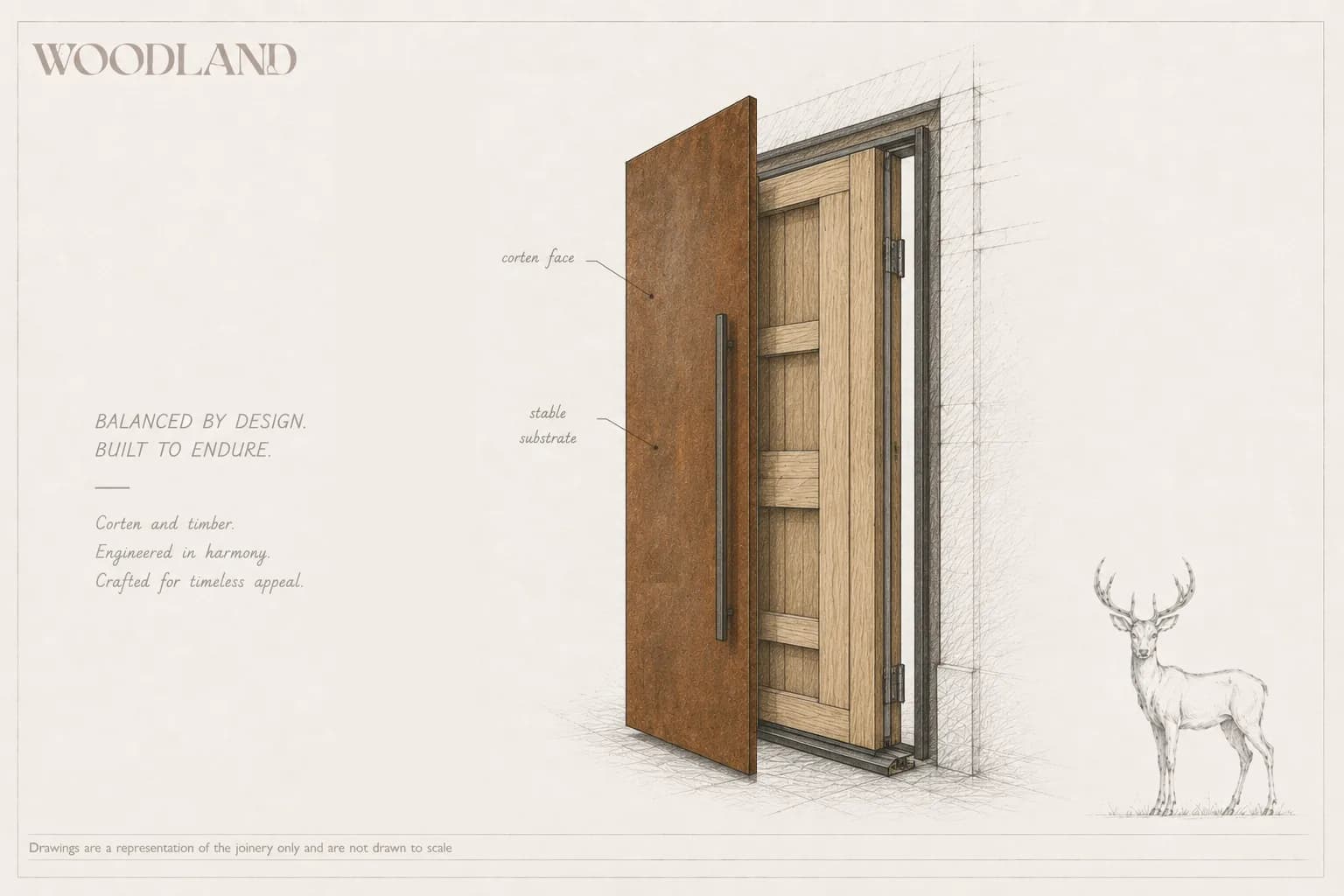
The build-up matters more than the idea. A sheet of weathering steel cannot simply be fixed to the face of a door: steel and timber move at different rates and in different directions, and a rigid sheet screwed to a moving leaf will either distort the door or tear its own fixings out. The steel has to be carried on something that mediates between the two.
The studio builds the face as a laminate. The corten sheet is bonded to a marine-grade plywood substrate, which gives the steel a stable, dimensionally reliable backing and spreads any movement across the whole panel rather than concentrating it at fixings. That panel is then rebated into the oak leaf, so the steel sits within the door rather than on it, and the edge of the timber frames and protects the edge of the steel. The result is a door that is structurally an oak door — with an oak door’s weight distribution, thermal behaviour, and ability to take locking and seals — wearing a corten face.
Weight is the consequence to plan for. A steel-faced leaf is substantially heavier than the same door in timber alone, and that has to be carried. It is one of the reasons the pairing suits a pivot door particularly well: a pivot carries the leaf on a bearing set into the floor and head rather than on side hinges, so the extra mass is taken by the structure rather than hung off a frame. A heavy corten leaf on a pivot opens with a fingertip. The same leaf on conventional hinges is a specification problem.
The patina, and the staining question
Left to weather naturally, corten sheds rust-coloured runoff while its patina is forming. This is the single most common complaint about the material and the one most often ignored at design stage: rainwater running off a weathering surface carries oxide with it, and that oxide stains whatever it lands on. Porous, pale materials — concrete, render, limestone, light paving — mark readily, and the marking is difficult to remove. A corten door set above a pale stone threshold, detailed without thought, will write its own history down the step beneath it.
There are two honest answers. One is to design for it: throw the water clear with a drip detail, keep porous surfaces out of the runoff path, or choose a threshold material that will not show it — and accept the staining as part of what the material does. The other is to stop it at source by sealing the face, which is the approach the studio takes on a door: the corten is sprayed with a clear satin lacquer once the patina has reached the tone the design wants.
Sealing has a consequence worth being clear about, because it is often sold as a free lunch. A lacquered corten face stops shedding oxide, so the staining problem goes away — but it also stops weathering. The patina is held at the moment it was sealed rather than continuing to deepen, which is an aesthetic decision, not a technical one, and it should be made deliberately. It also makes the face a coated surface, and coated surfaces are maintenance items rather than permanent conditions.
Coastal and exposed settings
The standard guidance on weathering steel is unambiguous: it should not be used untreated in marine environments, or anywhere it is exposed to de-icing salts. The reason is specific. The protective patina only stabilises through repeated cycles of wetting and drying in air that is essentially free of chlorides. Salt disrupts that process — chlorides prevent the oxide layer from becoming dense and adherent — so in salt-laden air the steel does not settle into a stable patina. It simply keeps corroding.
That does not put corten out of reach on a coastal building, but it does change what has to be done. The face has to be sealed rather than left to weather, and the seal has to be maintained: a clear lacquer over a stabilised patina puts a barrier between the salt and the steel, and it is what makes a corten face viable on a beachfront elevation. What it does not do is make the door maintenance-free. A coating in salt spray and full ultraviolet is working hard, and it will not last indefinitely. It should be inspected, and it will need recoating in time — because the failure mode of a breached coating is worse than no coating at all, moisture finding its way underneath and working unseen.
Anyone specifying corten within reach of the sea should be told this plainly before the door is made, not after. It is a material that rewards being understood and punishes being assumed.
Where corten is not the answer
Corten needs to dry. A face that stays permanently damp — deeply recessed under a soffit that never sees sun or moving air, sheltered where water sits rather than runs, or buried behind planting — never completes the wet-and-dry cycle the patina depends on, and the steel corrodes rather than protects itself. Shelter, counter-intuitively, is a problem rather than a kindness.
It is also the wrong material for a period building. That is not a technical judgement but an architectural one: weathering steel is a contemporary language, and on a listed or period elevation it reads as an intrusion rather than an intervention. The studio does not put it there, and a conservation officer would not permit it if it did.
And it is the wrong answer if what is actually wanted is a colour. If the brief is a dark, rich, textured front door, a painted or stained timber leaf will deliver it for less money, less weight, and less maintenance. Corten is worth its cost when what is wanted is the material itself — its mass, its depth, and the fact that it is visibly steel — and not before.
Specifying a corten and timber door set
A corten and timber door set is specified as an assembly, not as a door with a finish. The specification needs to fix the substrate and how the steel is carried; the timber species and core of the leaf behind it; whether the patina is to be weathered naturally or stabilised and sealed, and at what tone; how the leaf is hung, given its weight; how water leaving the face is thrown clear of what is beneath it; and what the maintenance expectation is over the life of the door, stated honestly.
Get those decided at design stage and the door is straightforward to build and behaves for decades. Leave them to be resolved on site and the result is a heavy door on the wrong ironmongery, staining a threshold it was never detailed to protect, in a finish nobody chose.