

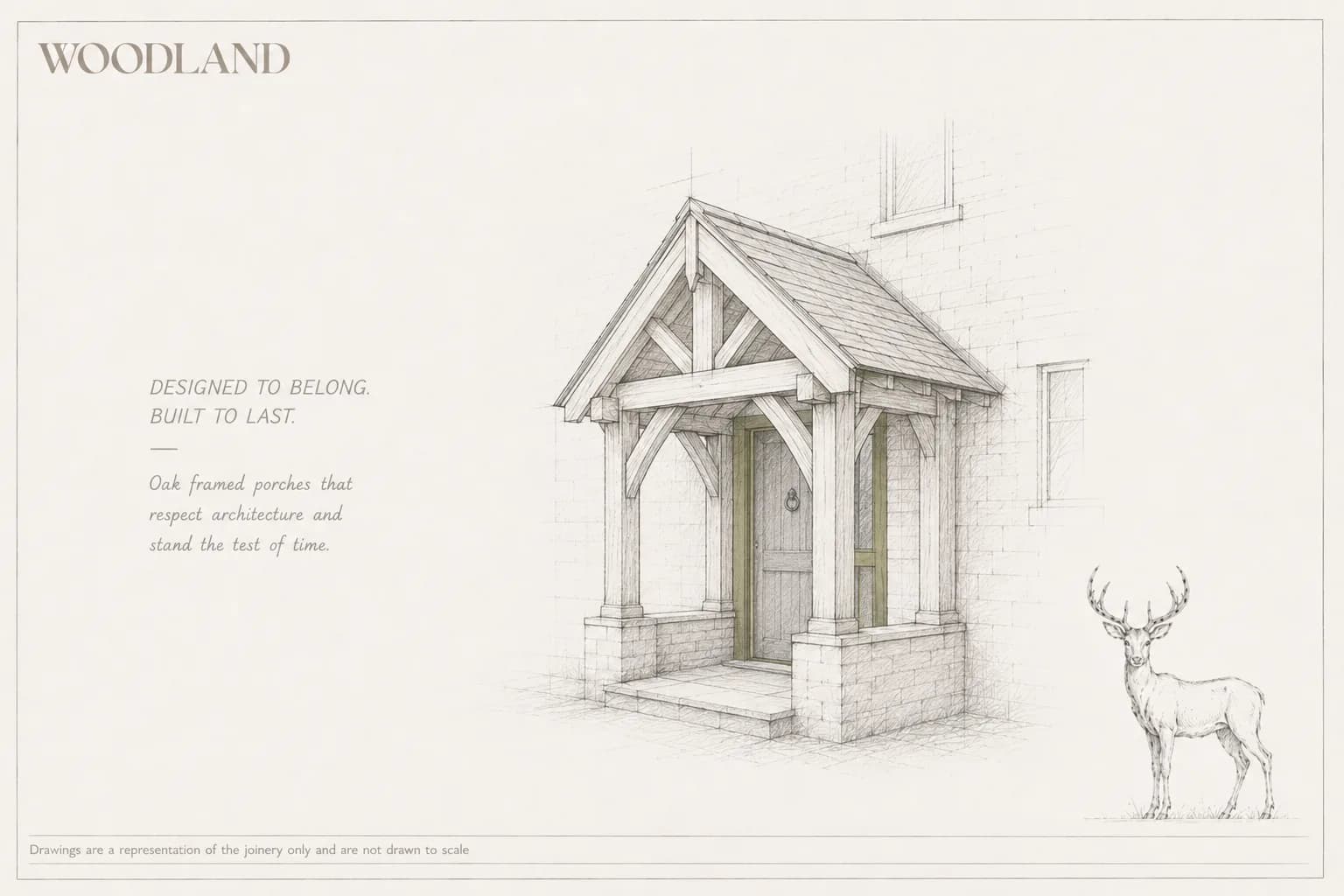
A porch is an architectural decision
A porch changes the front of a house. It alters the proportion of the elevation, the approach to the door, and the way the building meets the ground — which is why a porch that has been sized and detailed as an afterthought always looks like one. An oak-framed porch earns its place by answering to the building: its scale set against the door and the façade, its pitch taken from the existing roof, its posts and braces proportioned to carry the eye, not only the load. The frame is the architecture, and the architecture is decided before the joints are cut.
Green oak: what it is, and why it is used
A traditional oak frame is built from green oak — freshly sawn timber, still high in moisture, worked while it is relatively soft and stable to cut and joint. It is the material the great timber frames of the region were built from, and it is used for the same reasons now: it is strong, durable, and it locks tight as it dries. Air-dried oak has its place — generally for finer, smaller, or internal work — but for a structural porch frame, green oak is the default, not a compromise.
Jointing: mortise, tenon, and oak peg
A proper oak frame is held together by its joinery, not by steel. The members are cut with mortise-and-tenon joints and drawn tight with riven oak pegs (treenails), so the frame carries its loads through timber-to-timber connections the way a historic frame does. Done correctly, the joints tighten as the green oak dries and shrinks onto the pegs. Concealed steelwork is used only where a span or a load genuinely requires it — and on a porch frame it rarely does. The visible frame should be doing the work it appears to be doing.
Movement, shakes, and silvering: designed for, not faults
Green oak behaves like the living material it is. As it dries it shrinks, develops shakes — surface splits that run along the grain — and moves slightly at the joints before settling. None of this is a defect; it is the expected behaviour of a green oak frame, and a frame designed by someone who understands oak accommodates it. Over a few years the surface silvers to the familiar grey as the tannins weather, and the frame settles into the tight, permanent structure it was designed to become. A client who is told to expect shakes and silvering sees a frame maturing; one who is not sees a frame failing.
Proportion and the elevation
Scale is where most porches go wrong. Too small, and the porch looks mean against the door; too large, and it overwhelms the façade. The frame is proportioned to the building — the height and width set against the door opening and the elevation, the roof pitch matched to the house, the posts and braces sized so the structure reads as deliberate. On a period or rural property this proportion is the difference between a porch that looks original and one that looks added.
Planning, curtilage, and listed buildings
A porch is building work, and on many properties it needs permission. Modest porches often fall under permitted development, but the limits are real — and they fall away entirely on a listed building, within its curtilage, or in a conservation area or AONB, where listed building consent or planning permission is required and the design is judged against the building’s significance. An oak porch on a listed property is specified the same way as any heritage joinery: scaled and detailed to suit the building, and agreed with the planning or conservation officer before it is made.
What gets it right
An oak-framed porch belongs to a period or rural property when it is built the way the building’s own structure was: green oak, mortise-and-tenon joints drawn with oak pegs, proportion taken from the elevation, and a frame designed to move, shake, and silver into place. Specified that way — and, where consent is needed, agreed before manufacture — it reads as part of the house rather than an addition to it.