

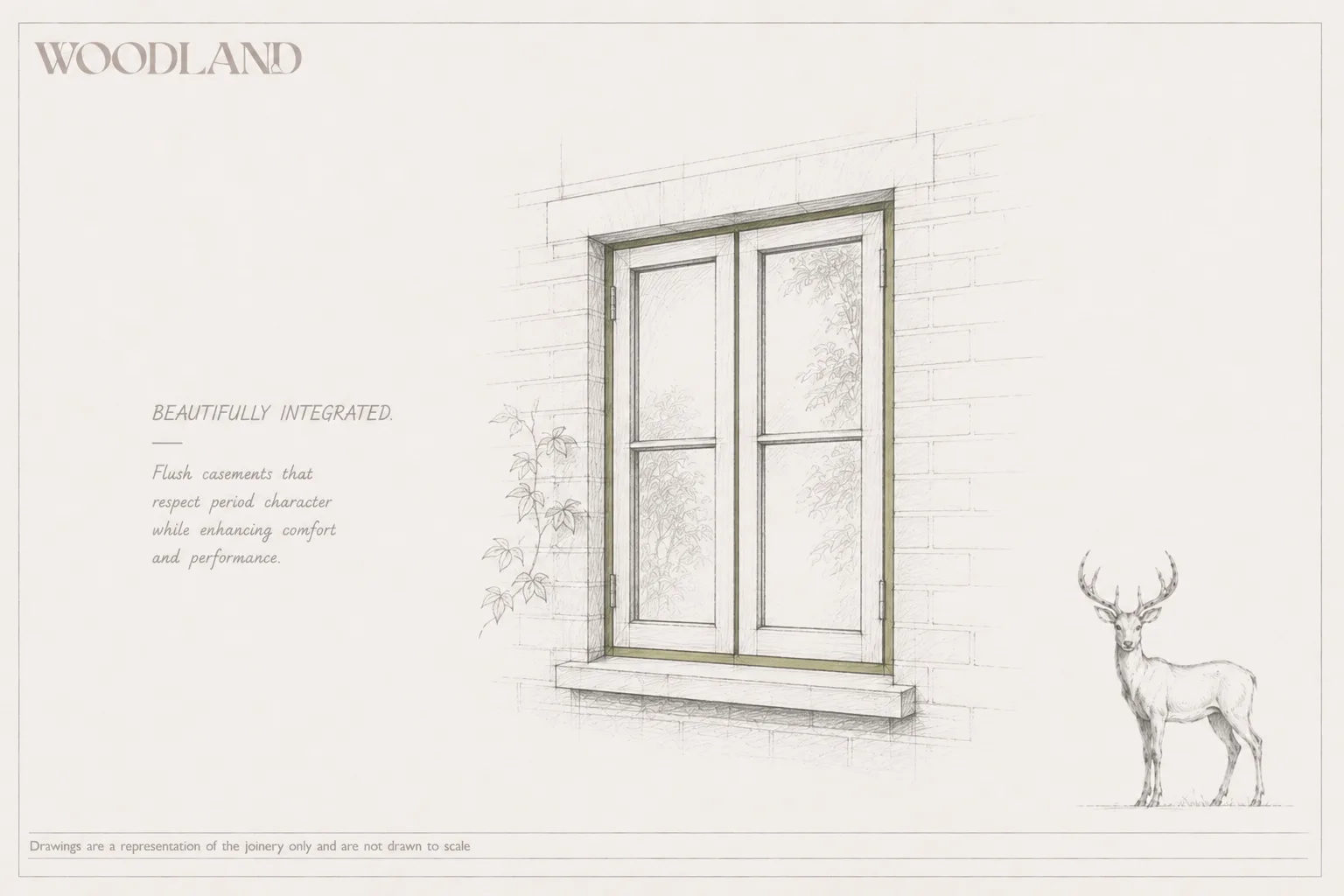
What a flush casement actually is
The flush casement is the older of the two timber casement windows, and the one period properties were built with. Its name describes it exactly: when the window is closed, the opening sash sits flush with the face of the frame, so the whole window reads as a single flat plane. The alternative — the stormproof or lipped casement — is a twentieth-century development in which the sash is rebated and sits proud of the frame, with an overlapping lip designed to throw off water. It is more weatherproof by default, and it looks it: the lip casts a deep shadow line around every opening light, breaking the elevation into a grid of raised panels.
Why the difference shows on a period elevation
A period window was designed as part of a flat, ordered façade — slim sections, a shallow reveal, and a continuous plane broken only by the glazing bars. A flush casement preserves that. A stormproof casement does not: the proud sash and its lip add a second, heavier shadow line that the original architecture never had, and the eye reads it instantly as modern, even from across a street. On a listed or conservation-area property it is one of the first things a conservation officer will refuse, because it changes the character of the elevation even when the proportions and materials are otherwise right.
The Victorian context
The Victorian sash window dominates the terraced townhouse, but the casement has its own strong Victorian tradition — in cottages, lodges, estate and farm housing, Gothic Revival, and the Arts-and-Crafts properties of the period’s later decades. On those buildings the flush casement, often with a peg stay and a casement fastener and frequently carrying leaded or multi-pane glazing, is the correct window. Replacing it with a stormproof casement — or with a sash — is as wrong as putting a flush casement into a sash-windowed terrace. The window has to answer to what the building was built with.
Sightlines, sections, and proportion
What makes a flush casement read correctly is the slimness of its parts and the flatness of its plane. The stiles and rails are kept slender, the glazing bars — where the window is divided — are fine and moulded, and the whole sash sits within the frame rather than over it. Get the sections too heavy, or the sash proud, and the window coarsens. Reproducing a period casement therefore means matching the original sections and the depth of the reveal, not just the overall opening — the same discipline that governs any period joinery.
Performance without the lip
The usual argument for the stormproof casement is weather performance, and it is the wrong trade to make. A well-made flush casement can be brought to modern standards without abandoning its flat face: concealed compression draught seals let into the rebate seal the window without a visible lip, and a slim-profile double-glazed unit in a correct moulded bar adds thermal performance while holding the sightline. The result is a window that performs like a modern one and reads like the original — which is exactly what a period elevation needs, and what the stormproof casement cannot give.
Ironmongery and the period detail
On a flush casement the ironmongery is part of the architecture, not an accessory. Traditional casement stays (peg stays) and casement fasteners in a finish appropriate to the property — and, where the building justifies it, forged or period-pattern hardware — complete the window. As with the joinery itself, the ironmongery is specified to the period of the building; on a listed property it is often where a conservation officer looks first.
What gets it right
A flush casement works on a period property because it does what the original did: it sits flat in its frame, keeps slim sections, carries the right glazing and ironmongery, and lets the elevation read as it was designed to. The specification that succeeds names the sections, the flush detail, the glazing, and the ironmongery, and matches them to what survives on the building or to its period and elevation — not to a stormproof standard borrowed from a different kind of window.