

Two requirements, one door
Insurers commonly specify thief-resistant locks to a recognised standard on final exit doors, and the schemes that inform that expectation — the British Standard for thief-resistant lock assemblies, the enhanced doorset standard, and the police-preferred specification scheme — are all written around modern doors and modern frames. They assume a door built to accept them.
Listing assumes the opposite. It protects a building’s special interest, and on a period door that interest frequently includes the door itself, its frame, its glass and its original ironmongery. Cutting a deep lock case into a historic stile is an alteration to protected fabric, not a fitting-out decision, and it may be irreversible.
The mistake is to treat one of these as the real requirement and the other as an obstacle. Both are real. What resolves them is that the insurer’s underlying interest is a secure door, not a specific product — and there is more than one way to make a door secure.
What listing actually restricts
Listing covers the building and its fixtures, and consent is required for works affecting its character as a building of special architectural or historic interest. That test is about effect, not about how large the job feels. A discreet-looking alteration to an original door can matter more than a visible one to a later addition.
In practice the questions an officer will ask about security work are consistent: what is being removed, whether it is original, whether the change is reversible, and whether the same protection could be achieved with less intervention. Security is a legitimate purpose and officers deal with it regularly — but it is not an exemption, and works are not permitted simply because their purpose is safety.
Original locks and hinges are frequently the oldest surviving components of a period door, occasionally older than the door itself. Assume the ironmongery is fabric until the local authority says otherwise; the studio’s guide to period door ironmongery covers why that assumption is usually correct.
The alternatives that satisfy both
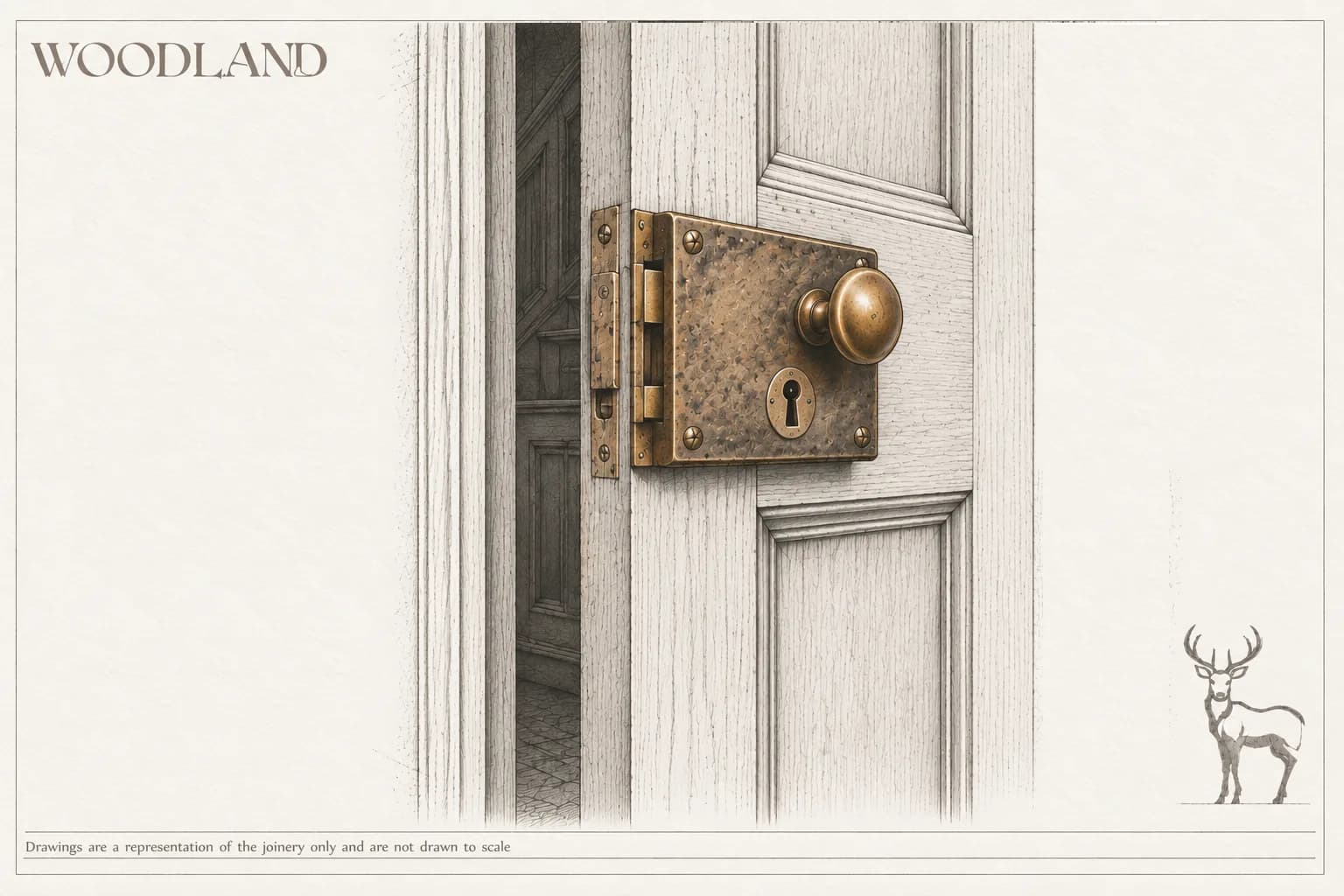
Most of the workable answers share a principle: add security without subtracting fabric. A rim-mounted lock fixes to the face of the door and cuts nothing out of it, which is both the conservation answer and, on a slim historic stile, the structurally sound one. Certified rim options exist, and they are the first thing to look at where a mortice case cannot be accommodated.
The frame is the second place to look, and it is routinely overlooked. A door is only as secure as its keep, and a keep screwed into perished lime holds very little. Reinforcing the keep, lengthening its fixings and improving the frame’s own fixing into the masonry raises the resistance of the whole assembly without touching the door leaf at all. Hinge bolts do the same job on the hanging side, and they are small, reversible and cheap in the sense that matters here — they cost no fabric.
The other move is to keep the original and add a second point rather than replace. An officer who would refuse the removal of an original lock will often accept it being retained in place, working or not, with a discreet additional fastening elsewhere on the door. The historic component stays; the door gets more secure. That is the shape of solution the process is designed to produce.
On a glazed door, the lock is rarely the weak point
A certified lock on a door with a large single-glazed panel beside it protects the part that was not going to fail. On glazed period doors and adjacent sidelights the glass is usually the easiest route in, and upgrading the lock while leaving the glass untouched is a specification that satisfies a checklist rather than a threat.
Laminated glass is the relevant answer, because it holds together under attack rather than breaking clear — and it can often be specified in a thickness and a finish that reads correctly on a period elevation, which modern sealed units frequently cannot. Where original or early glass survives, it is itself fabric, and secondary glazing set behind it protects both the glass and the opening without altering either. That does thermal work at the same time, which is covered separately in the studio’s piece on conservation glazing.
Have the insurance conversation in writing, before the work
Insurers write standard specifications because most buildings are standard. Listed buildings are a recognised exception, and underwriters deal with them routinely — but the accommodation has to be asked for, and it has to be recorded. An owner who fits an alternative and mentions it at claim stage is in a materially worse position than one who agreed it in advance and has the correspondence.
The useful approach is to set out what is being fitted and why the standard specification is not available: the building is listed, the works would require consent, and here is the alternative and what it achieves. That is a conversation underwriters can act on. It is also, usefully, the same evidence a consent application needs, so the two pieces of work are largely one.
Security work can need consent, and often does
There is a persistent assumption that security improvements are exempt because they are sensible. They are not. Where the work affects the special interest of a listed building — cutting into an original door, removing historic ironmongery, replacing historic glass, altering a frame — listed building consent may be required, and carrying out such works without it is a criminal offence rather than a planning irregularity.
Listing itself is settled on the National Heritage List for England, but what a listing covers in detail, and whether a specific proposal needs consent, is a conversation with the local authority’s conservation officer. Pre-application discussion is worth more here than almost anywhere else, because the officer will usually be able to say which of several approaches they could support before drawings are paid for.
What gets it right
Add rather than subtract: rim locks over mortice cases on historic doors, reinforced keeps and frame fixings rather than deeper cuts into the leaf, hinge bolts, and an original lock retained in place alongside a discreet second point. Look at the glass before the lock on any glazed door, because that is usually where the assembly is actually weak.
Agree the alternative with the insurer in writing before the work rather than after a claim, and take the consent question to the conservation officer early — the evidence that persuades one tends to persuade the other. Security work on a listed building is not a conflict to be won by either side; it is a specification problem with better and worse answers, and the better ones almost always remove less.