

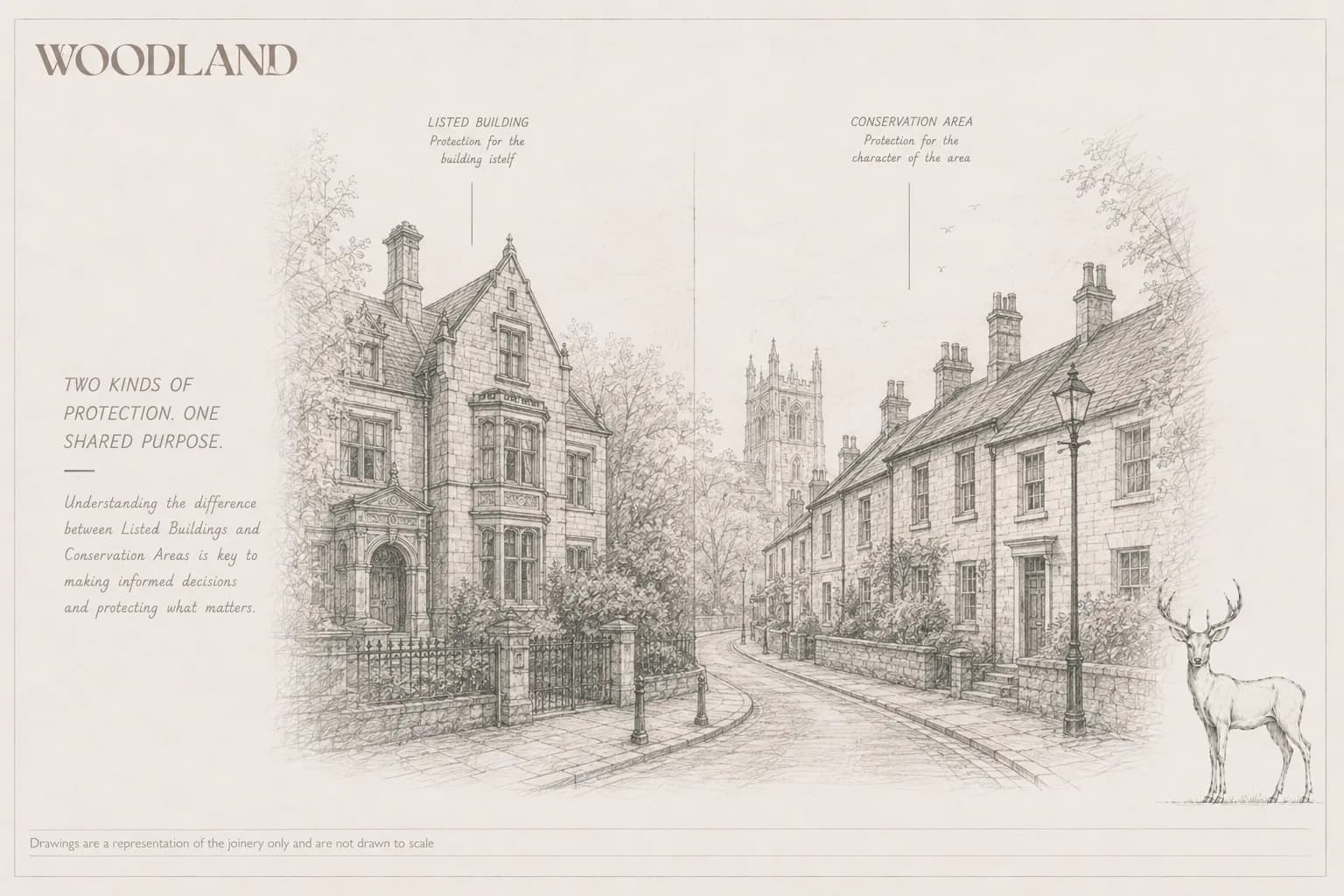
Two designations doing two different jobs
Both regimes come from the same statute — the Planning (Listed Buildings and Conservation Areas) Act 1990 — which is part of why they get muddled. What they do could hardly be more different.
Listing protects a particular building because of its special architectural or historic interest. The protection attaches to the whole of it: exterior, interior, later additions, and in some cases structures within its curtilage. Work affecting its character needs listed building consent, and carrying that work out without consent is a criminal offence.
Conservation area designation protects a place — a street, a village core, a mill complex — for the collective architectural or historic interest of the area. The council designates it and has a duty to preserve or enhance its character. The protection works mostly by tightening the ordinary planning system rather than by creating a separate consent for everything you touch.
The practical shorthand: listing asks what is special about this building. Conservation area designation asks what is special about this place, and how your building contributes to it. As with the rest of this article, that is the position in England — Wales runs a separate system under Cadw and the details differ.
Does a conservation area protect the inside of my house?
No — and this is the single most useful distinction to hold on to. Conservation area designation is concerned with what contributes to the character and appearance of the area, which in practice means the outside: elevations, roofscape, boundary treatments, the street scene. Internal alterations to an unlisted building in a conservation area are not controlled by the designation.
Listing is the opposite. Consent bites on the interior as readily as the exterior — panelling, staircases, plan form, internal doors and their architraves. Owners are regularly caught out by this, because nothing about the outside of the building signals it. It is the most common reason a project on a listed building needs consent when the owner expected not to need any.
Do I need permission to replace windows in a conservation area?
Usually not — unless an Article 4 direction is in force, and in conservation areas it very often is. For an unlisted house, replacing windows with units of similar appearance generally falls within permitted development, so no application is needed. That is the default position, and it is why conservation-area owners sometimes replace joinery without ever speaking to the council.
The default is fragile in two directions. Councils commonly make Article 4 directions over conservation areas precisely to withdraw those window and door rights, because original joinery is usually what gives a period street its character and is usually the first thing lost. And “similar appearance” is doing real work in that sentence: a stormproof casement replacing a flush one, or a change of material, is not a similar-appearance replacement even where the opening is unchanged.
On a listed building none of this applies. Wholesale replacement needs listed building consent regardless of how faithful the copy is, because the existing joinery is itself protected fabric — the ground covered in the studio’s guide to listed building consent.
What is an Article 4 direction, and how do I find out if one applies?
An Article 4 direction is a formal step by the local planning authority withdrawing specified permitted development rights across a defined area. It does not forbid the work; it removes the automatic permission, so the work now needs a planning application that will be judged against the character of the conservation area. Applications made necessary solely by an Article 4 direction carry no planning fee.
Finding out is a matter of record, not judgement. The council holds the directions it has made, usually mapped on its planning pages alongside the conservation area boundary, and the conservation officer will confirm what has been withdrawn. Two houses on the same street can sit differently if the boundary runs between them, so the check is worth making for the specific address rather than the neighbourhood. Settling it before anything is ordered is the cheapest step in the whole project.
Do I need conservation area consent?
Not in England — it no longer exists. Conservation area consent was abolished on 1 October 2013 by the Enterprise and Regulatory Reform Act 2013, and the control it exercised was folded into the planning system: demolition of most buildings in a conservation area now requires planning permission instead, with criminal liability still attached to doing it without.
This matters when reading advice online, because a great deal of it describes the pre-2013 regime — including the old volume thresholds that used to decide when consent was needed. If a page tells you to apply for conservation area consent in England, it is out of date. Wales does still operate conservation area consent, which is part of why the outdated advice persists.
For joinery this is mostly background, since replacing a window is not demolition. It becomes relevant where a project takes down a porch, an outbuilding, or a boundary wall as part of the work — the sort of thing that gets treated as incidental and is not.
The clause almost nobody expects: trees
Conservation area designation protects trees as well as buildings, and it catches people out. Trees in a conservation area that are not already covered by a Tree Preservation Order still cannot simply be felled or cut back: six weeks’ written notice must be given to the council under section 211 of the Town and Country Planning Act 1990, giving it the chance to make an Order. If the six weeks pass without one, the work may proceed, and that permission holds for two years.
It is worth knowing on a joinery project for a practical reason. Access for an oak frame, a large door set, or scaffolding sometimes means taking back a tree, and six weeks is long enough to derail a programme if it is discovered late.
What if work was done without permission before I bought?
Here the two regimes diverge most sharply, and the difference is the reason the question matters at all on a purchase.
A breach of listed building control has no time limit. However long ago the unauthorised work was done, enforcement remains available, and an enforcement notice binds the current owner regardless of who carried it out. Age is not a defence and neither is ignorance.
A planning breach in a conservation area does become immune eventually — but the clock is longer than most people believe. In England the immunity period became ten years for all breaches on 25 April 2024, under the Levelling-up and Regeneration Act 2023. The widely repeated “four-year rule” for operational development no longer applies to work completed after that date, and a good deal of published advice has not caught up.
For a buyer, the sequence is the same either way: compare the joinery against the building’s age, search the council’s planning record for the consent history, and route the question through a solicitor rather than ringing the council directly, since an informal enquiry can invalidate the indemnity insurance that is often the pragmatic answer to missing paperwork.
What if my building is both?
Many are, and the answer is that both regimes apply in full. Conservation areas cluster around exactly the historic cores where listed buildings are dense, so a listed building inside a conservation area is ordinary rather than unusual. Listed building consent governs the building itself, inside and out; the conservation area context shapes how the authority judges anything affecting the street scene, and the elevation is assessed for its contribution to the area as well as for its own special interest.
In practice the listing is the binding constraint and the conservation area sets the tone of the judgement. Both are settled by the same enquiry: whether the building is listed is checked in minutes on the National Heritage List for England, and the council confirms the conservation area boundary and any Article 4 direction alongside it.
What this means for specifying joinery
The regimes differ but the discipline they reward does not. Whether a window is judged for its contribution to a protected street or for its own historic fabric, what wins the argument is the same: profiles recorded from what survives, drawings an officer can assess rather than a description they must take on trust, and glazing specified to the building instead of chosen from a range. The studio’s work on a period property starts with establishing which regime applies and what has been withdrawn, because that answer determines what the specification has to prove — and a specification written to the right test tends to clear the first time.